The incentives are part of a $20 million program by Brookfield Properties to revitalise the mixed-use riverfront precinct ahead of the 2032 Brisbane Summer Olympics.
Up to 23 packages, ranging from $50,000 to $500,000, will be available to assist retailers with costs associated with opening new stores. This includes help with fit-out and design expenses, marketing support, and other startup costs. The aim is to curate a mix of retailers that align with the vision for the waterfront village.
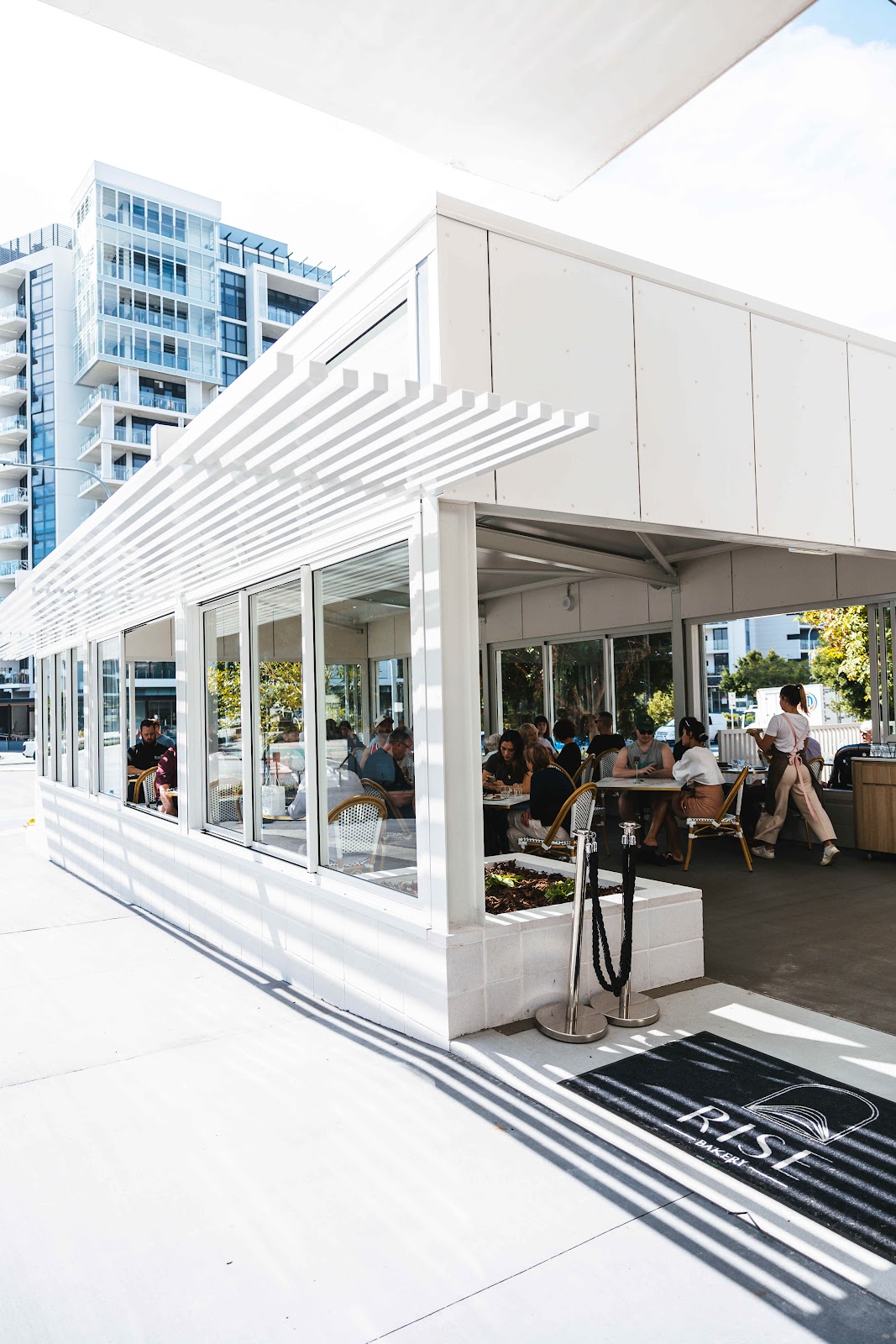
Rise Bakery at Portside Wharf (Photo supplied)
“We want to work with like-minded operators who will become an integral part of Hamilton and Brisbane at large,” said Brookfield Properties Executive Vice President Lee Butterworth.
With thousands of residents and workers in the area, along with a surge expected as the Olympics approach, Butterworth said the incentives will bring new energy to the village.
“This is our way of ensuring we bring the right partners to Portside and inject new energy into our village by the water. We’ll be making opportunities available for established businesses, emerging businesses and entrepreneurs,” said Mr Butterworth.
Retailers focused on health, wellness, waterfront dining, boutiques, and convenience are invited to apply.
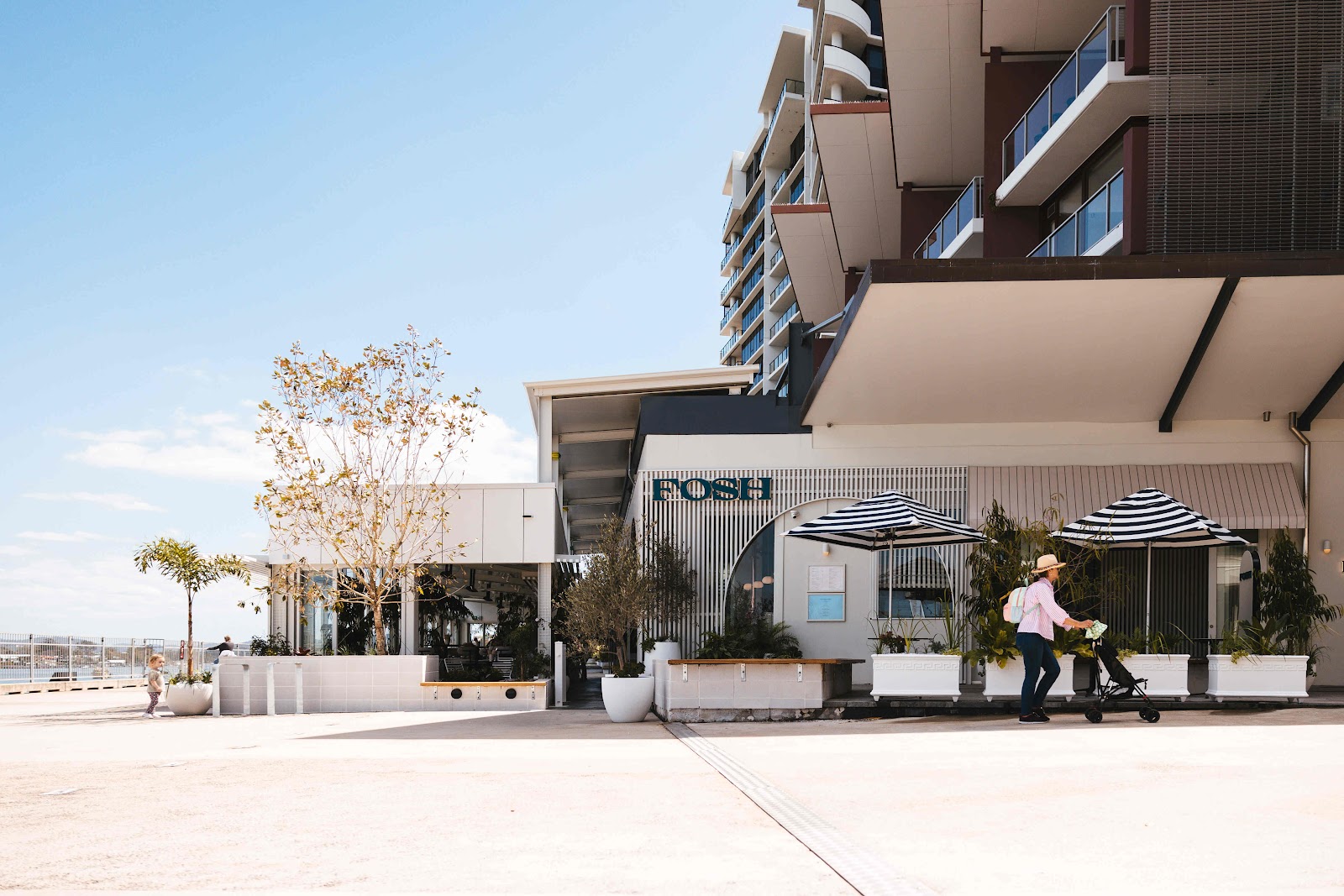
The revitalisation of Portside Wharf kicked off in 2023 with the addition of several new dining establishments. Fine dining seafood restaurant Fosh, led by renowned Brisbane restaurateur Michael Tassis, opened to offer upscale waterfront fare.
Fosh (Photo supplied)
French bakery and tea salon Rise Bakery brought Parisian breads and pastries to the village. Yakitori bar Bird’s Nest opened for Japanese skewers and shared plates. Artisanal gelato purveyor Rosé Gelateria also launched to provide frozen Italian treats.
The latest addition is Portside Social, a new 224 sqm venue modelled after the popular Newstead Social. Other upcoming openings include sushi restaurant Choo Choo Sushi and Chinese eatery Uncle Wang.
Portside Social (Photo supplied)
Interested retailers can apply for the incentives before April 19 at inportsidewharf.com.au. With the revitalisation underway, Portside Wharf aims to become a thriving retail and dining destination along Brisbane’s waterfront.
A recent health report has found that students attending schools in Hamilton, Ascot, New Farm, Bulimba, Balmoral, Hawthorne, and Hendra that are affected by chronic and excessive aircraft noise are experiencing negative academic results and struggling with their psychological well-being.
The World Health Organization recommends that daytime aircraft noise should not go beyond 45 decibels, and at night, it should stay below 40 decibels.
However, in Brisbane’s neighbourhoods like Bulimba, Hamilton, New Farm, and Tingalpa, the noise from planes often goes way above these levels, reaching 70-85 decibels.
Some areas have as many as 89 to 100 flights per day, with most of them being louder than 70 decibels, and some even louder than 90 decibels, as recorded by Airservices Australia’s noise monitors.
The health report, published by environmental scientist Dr Sean Foley in August 2023, sheds light on a pressing issue, its potential repercussions, and the divergent viewpoints regarding the proposed solutions.
Based on local surveys from 2021 and 2022, the study has identified a staggering 1.39 million Brisbane residents, equating to 54 per cent of the population, contended with aircraft noise in 2023. Among them, 242,000 individuals, or 9 per cent, bear the brunt of severe affliction.
Health Implications
The consequences of chronic exposure to aircraft noise extend beyond mere inconvenience. The report underscores a disconcerting array of health risks that affect the residents, ranging from sleep disturbance to cardiovascular disease. It highlights the disturbing link between aircraft noise and mental health disorders such as depression and anxiety.
The report also reveals the adverse impacts on children’s learning outcomes, with research showing that students attending schools under flight paths, including those in Bulimba, Balmoral, Hawthorne, Hamilton, Hendra, Ascot, and New Farm, are now experiencing negative academic results and struggling with their psychological well-being. The issue doesn’t stop at the school gate; it follows them home, compounding the challenges faced by these young residents.
The research estimates the health and social costs amounting to $9,000 per person, based on insights gleaned from a parallel study at Brussels Airport in Belgium. Potentially, the study says residents will face a potential healthcare cost of $18.9 billion by 2032.
In light of these findings, the Brisbane Flight Path Community Alliance (BFPCA) has called for the implementation of a curfew and flight cap at Brisbane Airport, akin to Sydney’s longstanding regulations. They assert that such measures would alleviate the suffering of affected residents.
However, Brisbane Airport Corporation maintains that roughly 70 per cent of noise complaints pertain to daytime flights. They argue that imposing a curfew may not provide the anticipated relief and could lead to unintended consequences, including diverted flights and increased prices. Instead, the airport is exploring alternative flight paths over Moreton Bay waters to minimize the noise impact on residential areas.
The Path Forward
Efforts to mitigate the adverse effects of airport noise are underway, with the airport authorities collaborating with Air Services Australia to devise strategies that reduce flight concentration over residential communities, including Hamilton.
The aim is to increase flight paths over the waters of Moreton Bay, thereby reducing the number of flights over homes. Air Services Australia, recognizing the mental distress caused by aircraft noise, now offers free mental health counselling services to affected Brisbane residents
The consequences of airport noise are not limited to specific suburbs; they reverberate across a wide swath of greater Brisbane, encompassing areas like Hamilton. Airservices Australia confirmed that residents in 226 suburbs, extending far beyond the Brisbane Local Government Area, have registered complaints about aircraft noise. This extensive problem impacts communities as far away as Upper Brookfield, Samford Valley, and Redland Bay, all while communities in Hamilton continue to bear the burden of this issue.
The Economic Dimension
Beyond the immediate health concerns, the issue carries significant economic implications, affecting not only specific areas like Hamilton but the entire region. While BFPCA argues for a curfew and flight cap, Brisbane Airport Corporation contends that such measures could negatively impact Queensland’s economy, projecting a shrinkage of $2.8 billion by 2032.
This estimate represents just 0.08 per cent of the state’s $360 billion economy, raising questions about the balance between economic growth and the well-being of affected communities.
Situated in one of the city’s most affluent areas, the motel in question has recently become a centre of contention as residents believe it poses an “imminent safety threat” to the community.
In a letter circulated among residents, the community expressed their discontent with the situation.
“We already have seen some action getting certain people removed, and we need your help to get back to the safe and quiet neighbourhood that we had prior to the placement of these people,” the letter says in part.
The motel, currently used as temporary accommodation for homeless individuals, is managed by Micah Projects, a government-funded homelessness support service. The letter urged locals to contact state politicians, the motel management, and Micah Projects, to reclaim their once safe and quiet neighbourhood.
Concerns and Accusations
The letter points out several concerns, including the conduct of some motel occupants, alleging that Micah Projects had not adequately screened those placed in the motel for shelter or provided ongoing support.
An anonymous Hamilton resident mentioned a recent incident involving a person with a knife threatening neighbours.
Micah Projects CEO Karyn Walsh responded by asserting that the organisation is actively addressing community concerns and that problematic individuals have been removed. The arrangement between the motel and Micah Projects has been in place for years, with vacant rooms being used for short-term accommodation for those in need.
According to Ms Walsh, the primary goal is to transition vulnerable individuals from temporary motel stays into permanent homes as quickly as possible. She emphasised that the motel, as a private enterprise, establishes its standards for guest behaviour, and non-compliance may result in eviction.
While Micah Projects has made significant strides in housing homeless families and individuals, the ongoing housing crisis in Australia continues to be a challenge. Factors such as rising rents and property sales have contributed to the issue.
Ms Walsh stressed the importance of efficient resource allocation and increased government housing to address the crisis and provide affordable shelter to those in need.
Despite community concerns, the Queensland Police Service (QPS) reported no specific increase in reports from the motel’s address. A QPS spokesperson encouraged concerned residents to report suspicious activity online or call 000 in emergencies.
Following the letter’s release, a homeless family was evicted from emergency accommodation, claiming the family was a threat to community safety. The family was subsequently moved to another hotel. The motel owner confirmed that the “residents of concern” had vacated the property.
This comes amidst Australia’s housing crisis. Many Australians are forced to live on the streets or in tents due to the situation. The National Shelter and SGS Economics and Planning report that property affordability has declined across most Australian capital cities, with regional Queensland being the least affordable for renters.
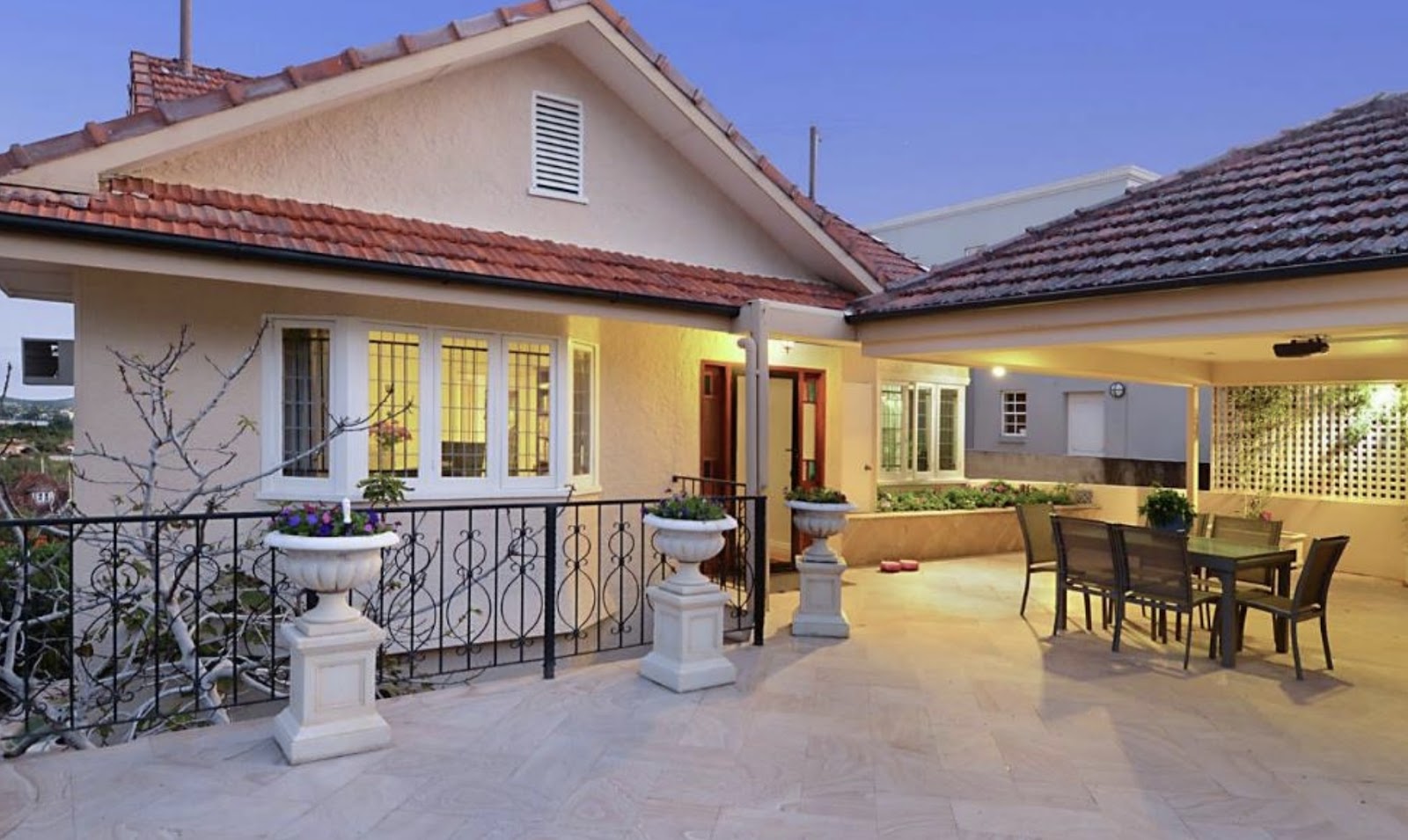
Developer Hua Feng Development Pty Ltd purchased the pre-1947 property at 33 Langside Rd two years ago and is now applying to tear down the four-bedroom house.
They commissioned a consultant’s report arguing that extensive modifications over the decades have stripped the transverse gable-style home of its original heritage character.
Real estate marketing photo of 33 Langside Rd, Hamilton, showing the gable roof form (Photo credit: realestate.com.au)
Changes include conversion to a duplex in the 1960s, a third storey addition in 1967, and a front carport added more recently. The report states these alterations, along with construction of larger modern houses nearby, have left the subject property looking out of place on the street.
Aerial view of subject property (Photo credit : Brisbane City Council)
Heritage consultant Malcolm Elliott concludes the 1940s home no longer retains its traditional charm and now appears “incongruous” among contemporary homes in the area.
Hua Feng submitted their development application to the Brisbane City Council in November 2023. Local officials are currently reviewing the proposal.
Can a Pre-1947 House Be Demolished?
A house or building constructed before 1947 that is also located in the Traditional building character overlay cannot be demolished. However, Council’s planning scheme allows for some limited exceptions where these older buildings can be removed.
In order for Council to approve demolition, the development application must meet the following criteria:
The building has undergone substantial alterations over time that have changed its original form and character.
The building has been deemed structurally unsound or unstable.
Demolition of the building would not result in a significant loss of traditional neighbourhood character.
The building is situated on a part of the street that no longer retains traditional building styles.
Additionally, if the house was built in 1911 or earlier, the only justification for demolition would be if the building is structurally unsound and not reasonably capable of being repaired.
In summary, local officials make some allowances for demolition of historic buildings in special cases, but there is a high bar to meet one of the qualifying criteria.
Hamilton’s Portside Wharf is gearing up to host the much-anticipated North Brisbane Vegan Markets, a vibrant hub of cruelty-free shopping, delicious vegan cuisine, and lively entertainment.
Scheduled for 18 Nov 2023, the Queensland Vegan Markets at Portside Wharf is at 39 Hercules Street, Hamilton. The event is set to run from 12:00 p.m. to 7:00 p.m., allowing visitors ample time to explore, shop, and dine.
Culinary Delights and Ethical Shopping
Photo Credit: Brisbane Vegan Markets/Facebook
Food enthusiasts will be spoilt for choice with an array of plant-based culinary delights. The event will feature a delicious assortment of vegan treats, from Balinese dishes to cheese toasties and tacos, not forgetting indulgent options like cupcakes, cookies, burgers, and loaded fries.
Photo Credit: Brisbane Vegan Markets/Facebook
The markets will also provide a platform for a variety of cruelty-free stalls, showcasing an array of products including leather alternatives, unique homewares, and bespoke goods.
An Inviting Atmosphere for All
Photo Credit: Brisbane Vegan Markets/Facebook
Setting the mood for this ethical extravaganza, live music will fill the air, creating an inviting and upbeat atmosphere. Pet lovers will be delighted to know that the event is pet-friendly, offering a chance for the community to enjoy a day out with their furry companions.
This inclusive approach underscores the market’s commitment to being a welcoming space for all attendees.
Entry is free, making it accessible to everyone. Attendees can also benefit from easy public transport access and both free and paid parking options, ensuring a hassle-free experience.
Slated for construction at 502 Kingsford Smith Drive, if approved, the development (DA A006335435) lodged in August 2023, is open for submissions from 25 Oct to 17 Nov 2023.
“Once a development application has been publicly notified, interested parties are invited to make submissions within a 20 business day public notification period. Following the 20 business day timeframe, the opportunity for submissions closes and the application is further assessed taking into consideration comments made by submitters,” per Economic Development Queensland.
Innovative Design and Amenities
Designed by the esteemed Myers Ellyett Architects, the proposal envisions a 5-storey residential tower with 44 high-density units, offering an array of amenities and communal spaces. The development is set to encompass levels 2 to 5, with an impressive communal rooftop space. Levels 2 and 3 will house 12 rooms each, whilst Level 4 boasts 2 landscaped terraces and 10 rooms.
Photo Credit: DA A006335435
The rooftop level, a truly standout feature, includes a café, yoga lawn, seating zone, function zone, and a garden edge. Furthermore, the ground level will feature a lobby, a convenient pick-up/drop-off area, three staff car parks, a loading/servicing zone, and lush planting and landscaping.
The project places a strong emphasis on aesthetics and community engagement, with screening and vegetation enhancing the building’s façade along Kingsford Smith Drive, affording residents private terraces and balconies. The rooftop area will provide a communal open space with outdoor landscaped spaces, a café, and a function area, all thoughtfully designed to complement the short-term accommodation use.
Photo Credit: DA A006335435
Promoting Streetscape Activation
Mewing Town Planning, the planners overseeing the project, are keen to ensure that the development aligns with the neighbourhood’s character and encourages street-level activation.
“At ground level, the development proposes the lobby and landscaped courtyard within proximity of the street frontage, consistent with the outcomes of the Neighbourhood Plan, which will encourage the activation and overlooking of the street,” the planner stated. “The landscaping within the frontage will soften the presence of the development and contribute to the character and amenity of the streetscape.”
Photo Credit: DA A006335435
The project includes a setback of 5.5 meters from the front boundary to prevent the development from overwhelming the streetscape. This setback, combined with an intricately designed façade, vertical batten screening, landscaping, and a central recessed form, ensures that the new addition to Hamilton integrates seamlessly with its surroundings.
Parking and Accessibility
A total of 22 car parking spaces are part of the plan, comprising 19 guest spaces, including three drop-off bays, and three staff spaces. Vehicle and pedestrian access will be facilitated via a shared driveway and a pedestrian entrance lobby. To accommodate environmentally conscious visitors, the proposal also includes 64 bicycle parking spaces, promoting sustainable transportation options.
The proposed development spans 1,281 square metres of gross floor area (GFA) with a site cover of 60 per cent. The development is set to invigorate the area and cater to the short-term accommodation needs of visitors and locals, creating a new landmark within the charming suburb of Hamilton.
Head to the BCC Development site to make a submission for DA A006335435.
The Bridge to Brisbane 2023 fun run is set to take over the city in October, with a beginner’s 4.5-km course that starts right in Hamilton, plus a more advanced 10-km course.
For more experienced runners, the 10km course takes participants across the bridge before finishing at the Showgrounds. The Bridge to Brisbane allows runners to raise money for charity while enjoying Brisbane’s landmark runs.
Shuttles will conveniently transport runners to the start of both courses on race day. In addition to free transport, entry to this year’s Bridge to Brisbane includes an official t-shirt and a finisher’s medal and certificate.
Entries close online on October 13 and in-person on October 14. Don’t miss your chance to be part of Queensland’s biggest community running event!
For those training for the Bridge to Brisbane or simply exploring Brisbane’s running options, the city offers a number of scenic riverside trails.
Brisbane’s City Botanic Gardens. Photo Credit: John Robert McPherson/Wikimedia Commons
The 5km route between QUT and New Farm offers stunning views of the Brisbane River and City Botanic Gardens. Extend the run to 10km by returning via Newstead.
The 4km waterfront course along Kangaroo Point Cliffs offers skyline views to motivate runners. Conquer the cliff stairs for an extra challenge.
Runners looking for greenery can hit the trails of Mt Coot-tha Reserve, just a 30-minute drive from Brisbane’s CBD. The 1.9km Summit Track takes runners to the viewpoint at the top of Mt Coot-tha’s iconic peak.
For a longer trail run, wind through the parklands along the Enoggera Creek Bikeway. Starting in The Gap, this 13km trail winds through the northside suburbs of Windsor, Wilston, and Newmarket.
With a range of scenic options for all levels, Brisbane runners are spoilt for choice. Lace up, get inspired and see the city from a fresh perspective.
Queensland’s music scene is set to take a giant leap towards inclusivity and accessibility as Spinal Life Australia joins forces with the Queensland Music Festival (QMF) to present a groundbreaking event, “Sweet Relief,” in Hamilton.
Despite the thriving cultural landscape in Queensland, accessibility and inclusivity often remain overlooked aspects of event planning, leading to social isolation for individuals with physical, sensory, and emotional disabilities. A recent survey revealed that people with disabilities aged 15–64 are twice as likely to experience social isolation (17%) compared to those without disabilities (8.7%). Additionally, a significant portion (39%) of people with disabilities feel a sense of unbelonging and dissatisfaction in their local communities due to the lack of accessibility.
Sweet Relief, a flagship event of the Queensland Music Festival and part of the Qld Music Trails, is set to change this narrative by pioneering innovative accessibility solutions in the music scene. Spinal Life Australia, a disability services and support organization, is collaborating with QMF to ensure that individuals with disabilities have the same opportunities to enjoy cultural events as everyone else.
The historic event will take place on Saturday, 16 Sept 2023, at the Maritime Green in Northshore Hamilton. The festivities kick off at 12:00 p.m. and continue until 10:00 p.m.
Some of the groundbreaking accessibility inclusions at Sweet Relief include:
Tactile Sensory Silent Disco: A Queensland-first experience designed to cater to neurodiverse and audio-sensitive audiences.
ConcertCare: On-ground support staff, including social workers, counsellors, nurses, and mental health peers, will be available to address attendees’ diverse needs.
Accessible Viewing Platform: A front-and-centre platform providing prime vision for individuals with disabilities.
Auslan Interpreters: Interpreters on-stage with fixed cameras to ensure that both the music and its lyrical essence are accessible to all.
Dane Cross, Spinal Life Australia’s Access and Advocacy Consultant, who himself lives with quadriplegia, expressed his enthusiasm for these pioneering accessibility measures.
“Arts, music, and events are a huge and important part of our culture, so it can be frustrating for the disability community to have limitations on what they can attend. These innovations and inclusions that Sweet Relief are championing aren’t about ticking a box; it’s about creating a sense of belonging and ensuring Brisbane, and the wider community, is welcoming of all,” Dane said.
When Dane was 21 years old, he experienced an injury that resulted in him living with quadriplegia. Instead of allowing this accident to define the end of his world, it propelled him onto a journey of advocacy and enhancing accessibility. This journey has culminated in a transformation of the music and event landscape in Queensland.
“We’re very proud and excited for Sweet Relief to represent a major step forward in creating exceptional audience experiences for everybody,” said Daryl Raven, QMF Chief Operating Officer. “QMF has a strategic focus towards diversifying our audience mix, and we hope to extend these initiatives across all Qld Music Trails events.”
A ‘sky forest’ is poised to redefine Hamilton’s skyline, as architecture firm Myers Ellyett reveals plans for a groundbreaking apartment building on Kingsford Smith Drive.
The firm describes the planned 14-level tower at 92 Kingsford Smith Drive as a gateway project that offers a “unique approach to urban living.” The development application (DA A006311523) was filed in July 2023.
Photo Credit: DA A006311523
The proposed site sits at the junction of the Brisbane River and Breakfast Creek, affording unobstructed panoramic views.
The architectural wonder will comprise 62 apartments, encompassing an array of 20 two-bedroom units and 42 spacious three-bedroom apartments.
Each of the 62 apartments will feature entry through sky gardens, providing open-air passages and private green havens.
The crowning glory of the structure will be a sprawling rooftop oasis spanning 1,048 sqm, adorned with a swimming pool, spa, gym with sauna, yoga lawn, private dining area, wine room, and barbecue space.
Photo Credit: DA A006311523
On the other hand, the lower levels will accommodate 148 car spaces, 78 bicycle spaces, and commercial tenancies, creating a holistic living experience.
Photo Credit: DA A006311523
The firm’s design philosophy draws inspiration from the subtropical surroundings of Brisbane, where indoor and outdoor living merge seamlessly. The edifice, soaring 14 levels above ground, has been conceptualized as two distinctive entities: the “trunk” and the “treehouses.”
The apartment building’s design reflects the fusion of indoor and outdoor living that is characteristic of homes in subtropical Brisbane , fostering a lifestyle surrounded by greenery and gardens.
Photo Credit: DA A006311523
The visionary behind the project is Industry Corp, with local entrepreneur Dennis Tomasel at the helm.
Mewing Planning Consultants, in their Town Planning Assessment, commended the project’s alignment with Brisbane’s subtropical ethos. They described the development as an embodiment of urban consolidation, catering to the demand for high-density residential spaces in a central location.
“92 Kingsford Smith Drive, Hamilton, embraces the region’s climate and leverages the site’s exceptional amenity and vistas. It exhibits a scale that complements and distinguishes itself from the surrounding urban landscape,” stated the consultants.
Wild Studio, renowned for landscaping, will shape the lush surroundings. Their vision entails creating a thriving forest that harks back to the site’s original landscape, offering residents enchanting outdoor spaces that celebrate the healing power of nature.
Supporting the city’s “Buildings That Breathe” initiative, the project sets out to establish new standards for eco-conscious urban living, infused with native greenery.
A tycoon’s plans to rebuild a home on Dickson Terrace has been met with strong opposition from fellow residents in the exclusive Hamilton neighbourhood.
The development application, which received approval in August 2022, entails the construction of a three-storey house designed by architects at Joe Adsett. The project has faced strong objections from local residents who are concerned about the potential impact of the build on their neighbourhood.
The main points of contention raised by fellow residents are the excessive height proposed for the development, which is beyond the height limit for residential areas, and the resulting overshadowing caused by said height.
Photo credit: Joe Adsett
According to the Dwelling House Code, the acceptable maximum building height for the area is two storeys and should not exceed 9.5 metres above ground level. The planners, on behalf of the applicant, argue that the proposed height aligns with the existing building heights of other structures in Dickson Terrace and the surrounding area.
Photo credit: Joe Adsett
One resident expressed shock and disappointment over the approval of a development on a neighbouring property that clearly breaches the established codes.
“In carrying out our due diligence in purchasing our property we researched the codes applying to our residential zone and took some comfort in understanding from these codes the limitations on developments that neighbouring properties could undertake,” the local wrote on a formal submission to Brisbane City Council.
Planning documents reveal that Gail Coyne, the wife of former State of Origin player Gary Coyne, is the primary applicant for the project. Mr Coyne, after retiring from his sporting career, made a name for himself as a restaurant owner, with at least nine McDonald’s franchises.