




By Jack Mercer – Rabbit Hole Fisherman
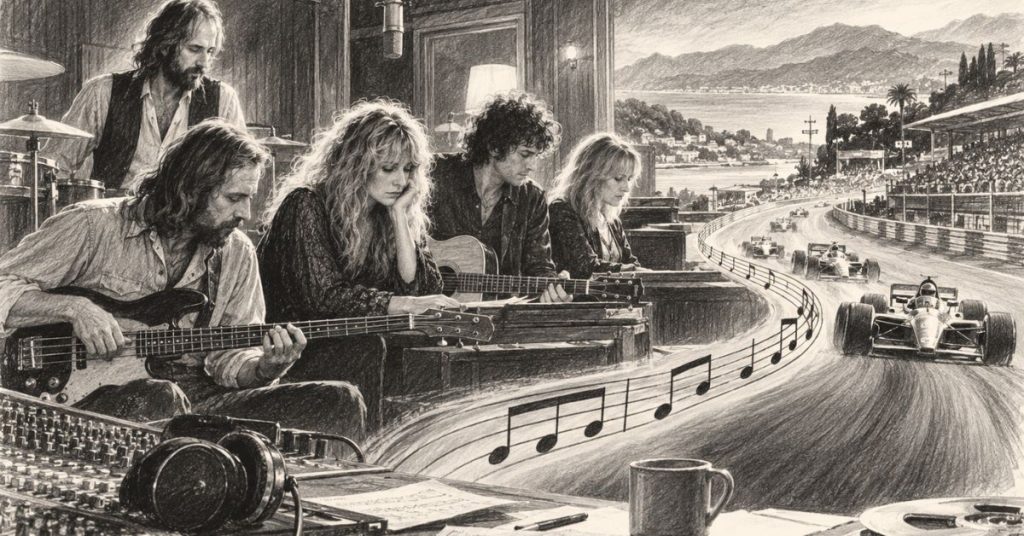
Five musicians, relationships under strain and a song assembled from discarded pieces: this is how Fleetwood Mac created a recording that millions would recognise without necessarily knowing its name.
For generations of Formula 1 fans, it has been one of the most recognisable sounds in sport.
In This Story
- Five musicians who had to keep working together
- The song that started with an ending
- A song credited to everyone
- Rumours arrives
- How The Chain became the sound of Formula 1
- A song with two lives
- The recording that nearly didn’t come together
A bass guitar begins playing a low, insistent pattern. The drums gather momentum. Then an electric guitar comes roaring in, and suddenly you are thinking about racing cars, starting grids and Sunday afternoons in front of the television.
It is a thrilling piece of music. And for many people, that is where the familiarity ends. They know the sound and what it means, but might struggle to name the song.
The music is the closing section of Fleetwood Mac’s The Chain, from their 1977 album Rumours. Its history is almost as extraordinary as the circumstances in which it was recorded.
The five musicians responsible were working through considerable personal difficulties. Lindsey Buckingham and Stevie Nicks were separating, John and Christine McVie’s marriage was ending, and Mick Fleetwood’s marriage was under strain. Yet the group continued to record together.
Somehow, they produced one of rock’s most successful albums. Hidden among its more conventional songs was a remarkable musical puzzle: a composition that took shape from fragments and extensive studio work.
Five musicians who had to keep working together
Fleetwood Mac began in Britain in 1967 as a blues band associated with guitarist Peter Green. Mick Fleetwood and John McVie were central to its early sound. Christine McVie later joined, adding a distinctive voice and gift for melody.
At the end of 1974, American musicians Lindsey Buckingham and Stevie Nicks joined. Their arrival helped reshape the group’s sound and commercial fortunes. The self-titled 1975 album brought international success with songs including Rhiannon, Say You Love Me and Over My Head.
By the time Rumours was being made, the band had become bigger, more ambitious and far more complicated. Making its successor meant bringing five people into the studio at a moment when several of their closest relationships were breaking down.
The situation is sometimes presented as an uninterrupted soap opera. That would diminish the work. Whatever their personal disagreements, these were highly capable musicians who could still listen, arrange, revise and perform together.
That combination of tension and discipline would define the record. The Chain would become the clearest example of it.
The song that started with an ending
During the Rumours sessions at the Record Plant in Sausalito, California, the group worked on a Christine McVie composition called Keep Me There, also associated with the working title Butter Cookie.
According to co-producer and engineer Ken Caillat, the musicians struggled to make the recording cohere. But during work on the track, John McVie came up with a compelling bass passage. The band built an energetic instrumental ending around it, with Buckingham adding guitar.
They had found something worth keeping. What they did not yet have was a finished song.
Caillat recalled that the group returned to the material repeatedly over many months. Its most exciting section was also its most awkward problem: how could the rest of the composition lead convincingly into that ending?
Late in the sessions, Buckingham devised a way forward. Rather than preserve the existing verses, he reworked the structure. Caillat described cutting blank tape into the recording, replacing sections, recording a new bass-drum pulse and changing the arrangement. Buckingham also played Dobro and reshaped the chorus.
This was analogue recording, not a digital workstation. Engineers physically edited multitrack tape, and the musicians built the finished performance from material recorded at different stages.
The Chain was not simply captured as one uninterrupted band performance. It was painstakingly assembled.
A song credited to everyone
The official songwriting credits for The Chain name all five members: Lindsey Buckingham, Mick Fleetwood, Christine McVie, John McVie and Stevie Nicks. It is the only track on the original Rumours album credited to the entire group.
Those credits are a more reliable guide than any attempt to assign each person one neat, exclusive piece of the finished song. Firsthand accounts describe an overlapping process of writing, arrangement, playing and editing, and recollections can differ in emphasis.
What is clear is that the finished recording depended on contributions from across the band, as well as the production work that brought them together.
There is an irony in that. People struggling to sustain their personal relationships found a way to make disconnected musical pieces function as a whole. But that is an observation about the finished work, not proof that all five intended a single symbolic message.
Rumours arrives
Released in February 1977, Rumours included Dreams, Go Your Own Way, Don’t Stop, You Make Loving Fun and Gold Dust Woman. It reached No. 1 in major markets and became one of the biggest-selling albums in recording history.
On the original LP, The Chain opened side two, following Christine McVie’s quiet Songbird at the end of side one. The contrast was striking.
The Chain begins with a measured pulse, acoustic textures and interwoven voices. It gradually builds, but its most familiar moment comes after the vocal sections have ended.
Then John McVie’s bass line takes over.
The passage works not because it is technically showy, but because of its tone, repetition and momentum. Fleetwood’s drums build around it; Buckingham’s electric guitar turns the ending into a release of accumulated tension.
The band’s official expanded Rumours editions include versions of Keep Me There and a demo of The Chain. These provide unusually direct evidence of how the musical ideas evolved.
Yet the musicians could hardly have anticipated the recording’s second life.
How The Chain became the sound of Formula 1
In 1978, the BBC adopted the closing instrumental section of The Chain for its Formula 1 television coverage.
The fit was immediate. The bass line creates anticipation; the drums add urgency; the guitar-led ending supplies a climax suited to pictures of racing cars and starting grids.
The association lasted through the BBC’s coverage until 1996. When ITV took over British Formula 1 broadcasting in 1997, it used other music.
When Formula 1 returned to BBC television in 2009, The Chain returned too. Its revival was greeted as the restoration of a familiar part of the viewing experience.
Channel 4 retained the music when it assumed Britain’s free-to-air coverage in 2016. But the association was not unbroken: reporting in 2019 documented Channel 4’s move away from The Chain as its signature theme.
The important point is not that one broadcaster used the same recording continuously forever. It is that a section of an album track became so closely linked to a sport that its return could itself become news.
A song with two lives
Music often escapes the circumstances of its creation. A song written about a relationship can become associated with a film, a family event or a sporting moment. Listeners attach their own memories to it.
The Chain has two particularly vivid identities.
On Rumours, it is part of a record made by five musicians working through a turbulent period. The structure itself bears the marks of experimentation and collaboration.
On television, its closing instrumental section signalled anticipation, speed and the start of a Grand Prix.
Those meanings are not in competition. They demonstrate how an arrangement can acquire a cultural life its creators never planned.
The title invites another tempting interpretation. A chain consists of separate links, and this was the only original Rumours track credited to all five members. But the history is stronger when we do not force every note into an allegory about the band’s relationships. The accounts of its creation are complicated enough — and interesting enough — on their own.
The recording that nearly didn’t come together
Return to the studio in 1976. There is a promising ending, an unfinished song and months of effort behind it. The band keeps trying. Sections are removed, new passages recorded and the structure rebuilt.
Caillat’s recollections show how close the material came to being abandoned as an unsatisfactory experiment.
Eventually, it works.
That would already be a satisfying ending to the story. But the more improbable development came later, when a British broadcaster found an entirely different purpose for its final instrumental passage.
The next time you hear The Chain, do not skip straight to the famous bass line. Start at the beginning. Hear the measured rhythm, the acoustic guitar, the voices and the gradual build.
When the bass arrives, the ending can seem inevitable.
It was not.
It took repeated attempts, inventive playing, physical tape editing and a band determined to complete a recording despite difficult circumstances.
Millions of people know how The Chain ends. Far fewer know how it was put together.
And that may be its greatest surprise: the music so many people associate with racing cars came from a song whose creators were working hard simply to make its separate pieces fit.