


The $160 Million Question: Australia’s Fight to Keep Phosphate Hill Producing Fertiliser

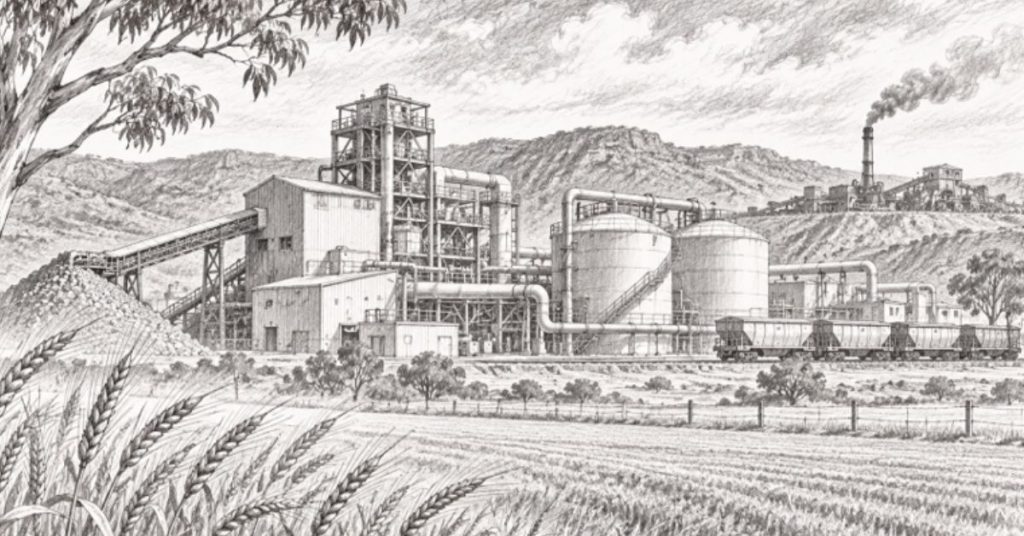
Conceptual pencil illustration showing the industrial connections between Australian fertiliser manufacturing, metal smelting and agriculture. Not a depiction of a specific facility.

By Jack Mercer – Rabbit Hole Fisherman

The Phosphate Hill fertiliser plant in north-west Queensland is the focus of a $160 million government loan facility aimed at preserving Australia’s only domestic producer of ammonium phosphate fertilisers. Its commercial difficulties have exposed the country’s dependence on an interconnected network of mines, chemical plants, gas pipelines, metal smelters and international shipping.

In This Story

Phosphate Hill processes locally mined phosphate rock into monoammonium phosphate and diammonium phosphate, commonly known as MAP and DAP. Both supply phosphorus and nitrogen, essential nutrients for crop growth.

Australia’s ability to manufacture these fertilisers depends on considerably more than access to mineral deposits.

The Mount Isa Industrial Connection

One of Phosphate Hill’s most important industrial relationships is with the Mount Isa copper smelter. Sulphur dioxide released during copper smelting can be captured and converted into sulphuric acid, which is used to process phosphate rock into phosphoric acid. Combining this with ammonia produces ammonium phosphate fertilisers.

A July 2024 sulphuric acid supply study prepared for the Queensland Government estimated that the state’s north-western and north-eastern minerals provinces consumed approximately 1.23 million tonnes of sulphuric acid in 2023. About 95% of that demand was associated with phosphate fertiliser manufacturing.

Regional supplies came from metal-smelting operations and acid manufactured from imported elemental sulphur.

The vulnerability became apparent in early 2025, when flooding disrupted rail transport and difficulties with acid production forced Phosphate Hill’s former owner to reduce its fertiliser production forecast.

Australia’s phosphate deposits had not disappeared. The disruption affected the industrial network needed to turn those deposits into usable products.

Global Sulphur Supply Under Pressure

Sulphur is recovered predominantly during oil refining and natural gas processing. Its availability is therefore tied to industries primarily concerned with producing fuels.

Conflict and shipping disruptions in the Middle East during 2026 placed pressure on international sulphur supplies, increasing costs for chemical manufacturers. The Strait of Hormuz is an important shipping route for this commodity.

China introduced another challenge. According to the OECD’s 2026 agricultural policy assessment, China announced a sulphuric acid export ban in April, effective from May.

Indonesia’s expanding nickel-processing industry has also increased demand for sulphuric acid. Some nickel ores are processed using high-pressure acid leaching, producing materials used in industrial products, including certain battery chemistries.

Technologies intended to reduce petroleum dependence can therefore increase demand for chemicals already required by agriculture.

However, elemental sulphur and sulphuric acid are different commodities. International disruptions do not establish that Phosphate Hill experienced a specific shortage because of China’s export ban.

A $1 Sale and a $160 Million Loan

On 30 June 2026, Dyno Nobel completed the sale of Phosphate Hill to Ryowa II GPS, a subsidiary of Mayfair Australia Corporation. The business became Southern Cross Fertilisers.

The transaction disclosure identified a nominal purchase price of $1, accompanied by a $50 million completion payment to the buyer, conditional deferred consideration and rehabilitation funding commitments.

The $1 price represented only one component of a substantially larger financial arrangement.

On 1 July, the Australian and Queensland governments announced a jointly funded $160 million loan facility to support modernisation and continued operations. Additional targeted assistance addressed elevated sulphur costs.

The intervention was intended to preserve domestic manufacturing capability and support related industrial operations. It did not guarantee long-term profitability.

Natural Gas and Manufacturing Costs

Sulphuric acid is only one of the factory’s major requirements. Natural gas is used to manufacture ammonia, which supplies the nitrogen component of MAP and DAP.

Industry Queensland reported on 18 November that Phosphate Hill consumes approximately 10 petajoules of gas annually.

At that consumption level, every $1 increase in the price of gas per gigajoule would add approximately $10 million to annual commodity expenditure, assuming consumption remained unchanged.

Southern Cross Fertilisers chief executive John Canavan has advocated domestic gas reservation arrangements. Gas industry representatives have warned that poorly designed policies could discourage investment.

Meanwhile, Glencore reported on 17 November that its Mount Isa copper smelter and Townsville refinery remained operational, despite deteriorating copper-smelting market conditions.

Neither development establishes that Phosphate Hill has returned to full production or profitability.

Agricultural Efficiency and Environmental Responsibilities

Soil testing, nutrient budgeting and more precise fertiliser application can help farmers reduce unnecessary expenditure. Researchers are also investigating phosphorus recovery from waste streams.

However, harvesting crops removes nutrients from agricultural systems. Fertiliser efficiency cannot eliminate the biological requirement for phosphorus.

Domestic manufacturing also carries environmental responsibilities. Conventional ammonia production relies on natural gas, phosphate mining requires rehabilitation, and phosphoric acid manufacturing generates phosphogypsum requiring appropriate management.

Australian-made fertiliser cannot automatically be assumed to have a smaller environmental footprint than imported products without a comparative lifecycle assessment.

The Economic Case for Domestic Production

The Phosphate Hill fertiliser plant supports specialised workers, regional businesses, freight services and related industrial operations. Its closure would leave Australian farmers more dependent on imported MAP and DAP.

In August 2026, Southern Cross Fertilisers outlined ambitions to extend the operation’s life to 2046, including a major 2027 maintenance shutdown estimated to cost between $80 million and $100 million. These remain plans rather than guaranteed outcomes.

The long-term value of the government loan cannot be determined without greater detail about repayment conditions, operating costs and future financial performance.

Australia’s phosphate reserves provide an important resource advantage, but mineral ownership alone does not deliver manufacturing self-sufficiency.

Preserving Phosphate Hill gives Australian farmers a domestic manufacturing option. Keeping that option commercially viable will depend on reliable chemical supplies, affordable energy, effective maintenance and sufficient revenue to sustain production.

Australia’s Diesel Dilemma: Can the World’s Biggest Machines Go Electric?

By Jack Mercer – Rabbit Hole Fisherman 

Australia exports almost all the crude oil it produces but imports most of the refined petroleum it consumes. In the Pilbara, electric mining trucks are testing whether some of that dependence can be reduced.

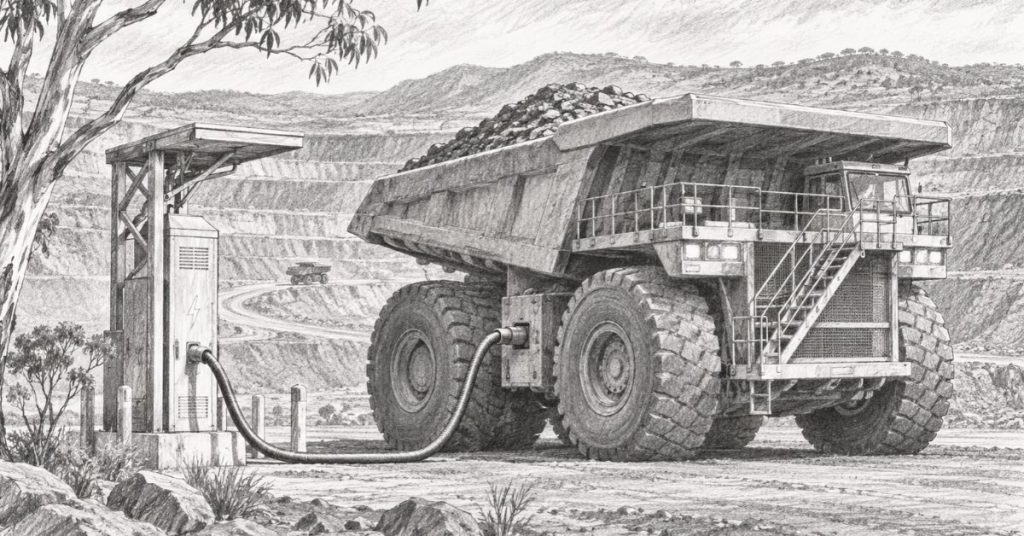
Australia’s diesel dependence is facing an unusual test at BHP’s Jimblebar iron ore mine in Western Australia, where two battery-electric Caterpillar haul trucks are undergoing trials that could have implications well beyond mining.

In This Story

In June 2026, BHP, Rio Tinto and Caterpillar reported that the vehicles had completed more than 200 test laps and accumulated over 100 operating hours. Testing on a dedicated track is helping engineers assess charging, reliability and performance in Pilbara conditions.

The trial remains a proof of concept. Replacing an entire diesel-powered fleet economically is a considerably larger challenge.

Australia’s Reliance on Imported Diesel

Australia is a major exporter of coal and natural gas, yet much of the liquid fuel used by its farms, mines, freight operators and construction companies comes from overseas.

Australian Government energy statistics show that imports supplied 80.8 per cent of refined petroleum consumption in 2024–25, while 95.7 per cent of domestic crude oil production was exported. Australian refineries also imported about two-thirds of their feedstock.

Part of the explanation lies in the differences between the crude oil Australia produces and the feedstock required by its remaining refineries. These trading arrangements expose Australian businesses to international fuel prices and overseas supply disruptions.

Under Australia’s Minimum Stockholding Obligation, regulated fuel suppliers must maintain minimum reserves. In the June quarter of 2026, government statistics showed that diesel stocks covered by these arrangements averaged the equivalent of 36 days of normal consumption.

That figure is not a prediction of how long Australia would function after a complete interruption to imports. Domestic refining, emergency measures and changing consumption would affect the outcome.

Alongside storage and supply diversification, reducing fuel consumption offers another way to address Australia’s diesel dependence.

China’s Electric Truck Market

The International Energy Agency’s Global EV Outlook 2026 reported that approximately one-quarter of new trucks sold in China in 2025 were electric, compared with nine per cent worldwide.

These figures represent new medium and heavy freight truck sales, not the proportion of electric trucks already on the road.

The IEA found that battery-electric heavy freight trucks in China could match diesel trucks on total ownership costs over five years under certain operating conditions.

Australia faces different circumstances. Charging infrastructure, electricity costs and distances between destinations can significantly affect operating expenses. China’s experience demonstrates commercial viability in some freight applications, but does not establish equivalent economics for Australian long-distance transport or mining.

Six-Megawatt Charging in the Pilbara

Mining haul trucks may carry hundreds of tonnes of material uphill before returning for another load. Charging interruptions must be carefully managed to maintain production.

Fortescue and its partners are developing fast chargers for battery-electric haul trucks in the 240-tonne payload class.

The Australian Renewable Energy Agency-supported project aims to demonstrate industrial charging equipment at an operating Pilbara mine.

Fortescue’s first chargers are rated at six megawatts, or 6,000 kilowatts, with a design objective of charging a haul truck in approximately 30 minutes.

An early engineering report identified a trade-off between compatibility and cost. Components that accommodated a wider range of battery voltages represented approximately one-fifth of the charger’s original design cost. Removing them reduced costs but limited compatibility.

In October 2026, Fortescue reported that its first chargers had been built and that automated connections took less than two minutes. Further testing was planned.

Mines must also establish how many chargers they need, where to install them and whether their electricity networks can support simultaneous charging. Equipment must withstand Pilbara conditions while meeting industrial electrical safety requirements.

The transition remains uncertain. ABC News reported in July 2026 that Rio Tinto continued investing in diesel trucks alongside its electric haulage trials.

The Limits of Farm Electrification

Mining and agriculture face different operating conditions. Mines generally control defined networks of haul roads, allowing charging infrastructure to be concentrated around established routes.

Agricultural machinery may operate across widely dispersed paddocks, far from suitable electricity connections. Harvesters also need to work for extended periods when weather and crop conditions permit, making charging interruptions difficult to accommodate.

The Australian Academy of Technological Sciences and Engineering identifies electrification opportunities in agriculture alongside significant infrastructure and technological challenges.

Smaller machines and stationary equipment, including irrigation pumps, may offer opportunities to reduce diesel consumption before large harvesters can be replaced economically.

From Fuel Imports to Equipment Imports

Electrification would not make Australia completely independent of overseas suppliers. Batteries, vehicles, power electronics and replacement components could remain dependent on international supply chains.

However, electricity can be generated using Australia’s own energy resources. Machinery powered by domestic non-diesel energy sources could reduce exposure to repeated fuel shipments and international diesel prices.

Environmental benefits would depend on electricity generation, battery manufacturing and equipment lifespan. Eliminating diesel exhaust does not eliminate all emissions associated with machinery production and operation.

Electrification could therefore improve one aspect of Australian energy security while creating different infrastructure and supply-chain requirements.

The Commercial Test for Electric Haulage

Australia will continue to need fuel reserves, reliable supply contracts and contingency plans. Existing diesel machinery will remain in service, and some applications may prove particularly difficult to electrify.

For mining companies, commercial viability will depend on vehicle prices, battery life, electricity infrastructure, maintenance, charging delays and the cost of moving material.

If electric haul trucks can eventually move ore at a competitive cost using electricity generated from domestic resources, mining companies will have a commercial reason to consume less diesel.

For Australia, that would mean reducing its exposure to imported fuel without requiring every component of the machinery to be manufactured here.