


The Queensland Farmers Who Decided Tractors Were Getting Too Big

By Jack Mercer – Rabbit Hole Fisherman

On their Central Queensland farm, Andrew and Jocie Bate began questioning the agricultural machinery industry’s enthusiasm for bigger tractors. Their alternative was autonomous farm machinery: smaller vehicles capable of working independently for extended periods. Today, their idea has become a commercial business, with Queensland farmers reporting substantial savings in agricultural operations.

In This Story

The Bates challenged an assumption that had shaped agricultural machinery for generations: increasing productivity required increasingly large and powerful machines.

Their approach was to increase productive working hours rather than continually increase the size of individual machines.

Challenging the Bigger Tractor Model

Farming at Gindie, near Emerald, the Bates began exploring autonomous agricultural technology in the early 2010s.

Large tractors and self-propelled sprayers allowed farmers to cover substantial areas quickly, but they also required significant capital investment and skilled operators.

The Bates envisaged smaller machines working independently across paddocks. With engineering assistance, they developed prototypes that eventually became the foundation of SwarmFarm Robotics.

Rather than designing a machine for a single agricultural task, SwarmFarm developed autonomous platforms capable of carrying different implements, including equipment supplied by specialist manufacturers.

The concept has since progressed from experimental machinery to commercial production, with a manufacturing presence on Queensland’s Darling Downs.

15,000 Hours on a Queensland Farm

The Coggan family’s mixed farming enterprise near Meandarra, in Queensland’s Western Downs, provides an example of autonomous farm machinery operating under commercial conditions.

The business covers approximately 26,300 hectares and introduced its first SwarmFarm robot in 2021, followed by a second in 2022.

Both machines are equipped with 18-metre spraying booms, 3,000-litre tanks and WEED-IT optical spot-spraying technology.

In a September 2026 report by Future Farming, Tom Coggan reported typical chemical savings of around 85% during fallow spraying, reaching 95% under some conditions.

Those savings primarily result from cameras identifying weeds and directing herbicide where needed rather than spraying entire paddocks. Autonomous navigation allows the machines to undertake that work without a dedicated driver.

By October 2026, the two robots had reportedly accumulated approximately 15,000 combined operating hours.

Each machine was covering around 13 hectares an hour while consuming between four and seven litres of diesel, depending on operating conditions.

The Economics of Driverless Spraying

In an October 2026 user review, Coggan estimated that operating costs were approximately 70% lower than conventional spraying.

However, that figure represents one farming enterprise’s reported experience rather than an independently audited comparison of total ownership costs.

Indicative manufacturer prices reported in September 2026 placed a SwarmFarm vehicle at approximately $360,000, with an automatic refilling system costing another $80,000. Implements, software subscriptions, servicing and other expenses also need to be considered.

The machines still require people to undertake maintenance, prepare operating areas and supervise their work.

For a large cropping enterprise with substantial annual machinery use, the investment may make financial sense. A smaller farm with fewer operating hours could reach a different conclusion.

Removing the Refilling Bottleneck

Building a machine that could navigate a paddock independently solved only part of the problem. A sprayer still needed someone to replenish its tank.

SwarmFarm developed AutoFill, a system allowing robots to return to a designated station, refill their spray tanks and resume work.

Coggan Farms introduced the technology in 2025.

At the September 2026 Henty Machinery Field Days, SwarmFarm presented a standalone version intended for compatible conventional spraying equipment as well as its autonomous platforms.

Reducing interruptions could allow machinery to complete more work without tying up staff who might otherwise be needed elsewhere on the farm.

A Different Result in Coonawarra

Not every application has produced favourable results.

A Wine Australia research project, completed in June 2025 and conducted by Treasury Wine Estates, assessed SwarmFarm technology for vineyard operations in South Australia’s Coonawarra region.

Although the machine met core safety, navigation and security requirements, the trial encountered frequent stoppages, sensitive obstacle detection and technical support difficulties.

The trial ended prematurely. Financial modelling based on the limited operating data indicated a negative return for inter-row slashing alone.

The findings do not establish whether those technical problems persist in newer machines. They do, however, demonstrate that autonomous machinery can be technically capable without being economically suitable for every agricultural application.

Beyond the Tractor Cab

In a 2026 innovation profile, the Queensland Government reported that SwarmFarm had delivered more than 250 robots working across more than 10 million acres, equivalent to approximately four million hectares. These deployment figures draw on company information rather than independently audited records.

Research published by Grain Producers Australia also identifies affordability, uncertain investment returns and connectivity as barriers to wider adoption.

Safety remains another consideration. Queensland’s Rural Plant Code of Practice 2024 addresses risks associated with autonomous agricultural machinery. Removing the driver does not remove the responsibility to operate equipment safely.

Conventional tractors remain important for heavy cultivation and other demanding agricultural operations. Smaller autonomous machines offer an alternative for particular tasks rather than a replacement for every piece of farm machinery.

The achievement of Andrew and Jocie Bate lies in demonstrating that agricultural productivity need not depend entirely on building bigger machines.

For some farming operations, increasing the time a smaller machine can work may be just as valuable as increasing its size and power.

The $160 Million Question: Australia’s Fight to Keep Phosphate Hill Producing Fertiliser

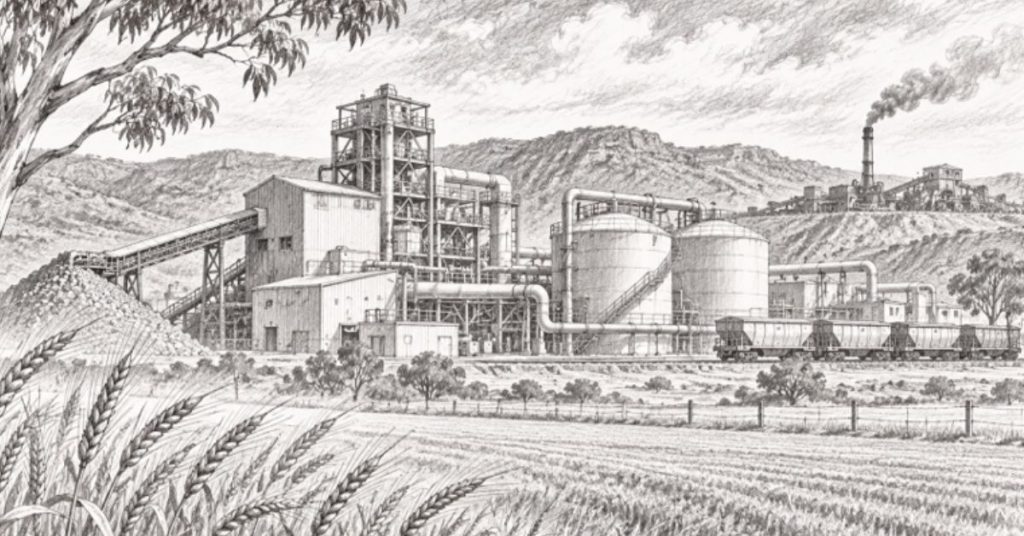
Conceptual pencil illustration showing the industrial connections between Australian fertiliser manufacturing, metal smelting and agriculture. Not a depiction of a specific facility.

By Jack Mercer – Rabbit Hole Fisherman

The Phosphate Hill fertiliser plant in north-west Queensland is the focus of a $160 million government loan facility aimed at preserving Australia’s only domestic producer of ammonium phosphate fertilisers. Its commercial difficulties have exposed the country’s dependence on an interconnected network of mines, chemical plants, gas pipelines, metal smelters and international shipping.

In This Story

Phosphate Hill processes locally mined phosphate rock into monoammonium phosphate and diammonium phosphate, commonly known as MAP and DAP. Both supply phosphorus and nitrogen, essential nutrients for crop growth.

Australia’s ability to manufacture these fertilisers depends on considerably more than access to mineral deposits.

The Mount Isa Industrial Connection

One of Phosphate Hill’s most important industrial relationships is with the Mount Isa copper smelter. Sulphur dioxide released during copper smelting can be captured and converted into sulphuric acid, which is used to process phosphate rock into phosphoric acid. Combining this with ammonia produces ammonium phosphate fertilisers.

A July 2024 sulphuric acid supply study prepared for the Queensland Government estimated that the state’s north-western and north-eastern minerals provinces consumed approximately 1.23 million tonnes of sulphuric acid in 2023. About 95% of that demand was associated with phosphate fertiliser manufacturing.

Regional supplies came from metal-smelting operations and acid manufactured from imported elemental sulphur.

The vulnerability became apparent in early 2025, when flooding disrupted rail transport and difficulties with acid production forced Phosphate Hill’s former owner to reduce its fertiliser production forecast.

Australia’s phosphate deposits had not disappeared. The disruption affected the industrial network needed to turn those deposits into usable products.

Global Sulphur Supply Under Pressure

Sulphur is recovered predominantly during oil refining and natural gas processing. Its availability is therefore tied to industries primarily concerned with producing fuels.

Conflict and shipping disruptions in the Middle East during 2026 placed pressure on international sulphur supplies, increasing costs for chemical manufacturers. The Strait of Hormuz is an important shipping route for this commodity.

China introduced another challenge. According to the OECD’s 2026 agricultural policy assessment, China announced a sulphuric acid export ban in April, effective from May.

Indonesia’s expanding nickel-processing industry has also increased demand for sulphuric acid. Some nickel ores are processed using high-pressure acid leaching, producing materials used in industrial products, including certain battery chemistries.

Technologies intended to reduce petroleum dependence can therefore increase demand for chemicals already required by agriculture.

However, elemental sulphur and sulphuric acid are different commodities. International disruptions do not establish that Phosphate Hill experienced a specific shortage because of China’s export ban.

A $1 Sale and a $160 Million Loan

On 30 June 2026, Dyno Nobel completed the sale of Phosphate Hill to Ryowa II GPS, a subsidiary of Mayfair Australia Corporation. The business became Southern Cross Fertilisers.

The transaction disclosure identified a nominal purchase price of $1, accompanied by a $50 million completion payment to the buyer, conditional deferred consideration and rehabilitation funding commitments.

The $1 price represented only one component of a substantially larger financial arrangement.

On 1 July, the Australian and Queensland governments announced a jointly funded $160 million loan facility to support modernisation and continued operations. Additional targeted assistance addressed elevated sulphur costs.

The intervention was intended to preserve domestic manufacturing capability and support related industrial operations. It did not guarantee long-term profitability.

Natural Gas and Manufacturing Costs

Sulphuric acid is only one of the factory’s major requirements. Natural gas is used to manufacture ammonia, which supplies the nitrogen component of MAP and DAP.

Industry Queensland reported on 18 November that Phosphate Hill consumes approximately 10 petajoules of gas annually.

At that consumption level, every $1 increase in the price of gas per gigajoule would add approximately $10 million to annual commodity expenditure, assuming consumption remained unchanged.

Southern Cross Fertilisers chief executive John Canavan has advocated domestic gas reservation arrangements. Gas industry representatives have warned that poorly designed policies could discourage investment.

Meanwhile, Glencore reported on 17 November that its Mount Isa copper smelter and Townsville refinery remained operational, despite deteriorating copper-smelting market conditions.

Neither development establishes that Phosphate Hill has returned to full production or profitability.

Agricultural Efficiency and Environmental Responsibilities

Soil testing, nutrient budgeting and more precise fertiliser application can help farmers reduce unnecessary expenditure. Researchers are also investigating phosphorus recovery from waste streams.

However, harvesting crops removes nutrients from agricultural systems. Fertiliser efficiency cannot eliminate the biological requirement for phosphorus.

Domestic manufacturing also carries environmental responsibilities. Conventional ammonia production relies on natural gas, phosphate mining requires rehabilitation, and phosphoric acid manufacturing generates phosphogypsum requiring appropriate management.

Australian-made fertiliser cannot automatically be assumed to have a smaller environmental footprint than imported products without a comparative lifecycle assessment.

The Economic Case for Domestic Production

The Phosphate Hill fertiliser plant supports specialised workers, regional businesses, freight services and related industrial operations. Its closure would leave Australian farmers more dependent on imported MAP and DAP.

In August 2026, Southern Cross Fertilisers outlined ambitions to extend the operation’s life to 2046, including a major 2027 maintenance shutdown estimated to cost between $80 million and $100 million. These remain plans rather than guaranteed outcomes.

The long-term value of the government loan cannot be determined without greater detail about repayment conditions, operating costs and future financial performance.

Australia’s phosphate reserves provide an important resource advantage, but mineral ownership alone does not deliver manufacturing self-sufficiency.

Preserving Phosphate Hill gives Australian farmers a domestic manufacturing option. Keeping that option commercially viable will depend on reliable chemical supplies, affordable energy, effective maintenance and sufficient revenue to sustain production.

Australia’s Diesel Dilemma: Can the World’s Biggest Machines Go Electric?

By Jack Mercer – Rabbit Hole Fisherman 

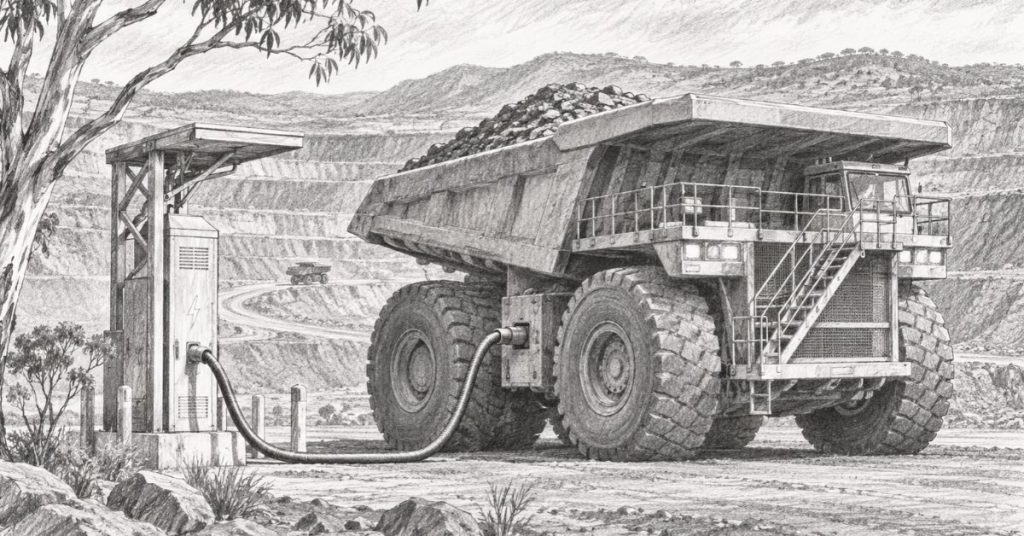
Australia exports almost all the crude oil it produces but imports most of the refined petroleum it consumes. In the Pilbara, electric mining trucks are testing whether some of that dependence can be reduced.

Australia’s diesel dependence is facing an unusual test at BHP’s Jimblebar iron ore mine in Western Australia, where two battery-electric Caterpillar haul trucks are undergoing trials that could have implications well beyond mining.

In This Story

In June 2026, BHP, Rio Tinto and Caterpillar reported that the vehicles had completed more than 200 test laps and accumulated over 100 operating hours. Testing on a dedicated track is helping engineers assess charging, reliability and performance in Pilbara conditions.

The trial remains a proof of concept. Replacing an entire diesel-powered fleet economically is a considerably larger challenge.

Australia’s Reliance on Imported Diesel

Australia is a major exporter of coal and natural gas, yet much of the liquid fuel used by its farms, mines, freight operators and construction companies comes from overseas.

Australian Government energy statistics show that imports supplied 80.8 per cent of refined petroleum consumption in 2024–25, while 95.7 per cent of domestic crude oil production was exported. Australian refineries also imported about two-thirds of their feedstock.

Part of the explanation lies in the differences between the crude oil Australia produces and the feedstock required by its remaining refineries. These trading arrangements expose Australian businesses to international fuel prices and overseas supply disruptions.

Under Australia’s Minimum Stockholding Obligation, regulated fuel suppliers must maintain minimum reserves. In the June quarter of 2026, government statistics showed that diesel stocks covered by these arrangements averaged the equivalent of 36 days of normal consumption.

That figure is not a prediction of how long Australia would function after a complete interruption to imports. Domestic refining, emergency measures and changing consumption would affect the outcome.

Alongside storage and supply diversification, reducing fuel consumption offers another way to address Australia’s diesel dependence.

China’s Electric Truck Market

The International Energy Agency’s Global EV Outlook 2026 reported that approximately one-quarter of new trucks sold in China in 2025 were electric, compared with nine per cent worldwide.

These figures represent new medium and heavy freight truck sales, not the proportion of electric trucks already on the road.

The IEA found that battery-electric heavy freight trucks in China could match diesel trucks on total ownership costs over five years under certain operating conditions.

Australia faces different circumstances. Charging infrastructure, electricity costs and distances between destinations can significantly affect operating expenses. China’s experience demonstrates commercial viability in some freight applications, but does not establish equivalent economics for Australian long-distance transport or mining.

Six-Megawatt Charging in the Pilbara

Mining haul trucks may carry hundreds of tonnes of material uphill before returning for another load. Charging interruptions must be carefully managed to maintain production.

Fortescue and its partners are developing fast chargers for battery-electric haul trucks in the 240-tonne payload class.

The Australian Renewable Energy Agency-supported project aims to demonstrate industrial charging equipment at an operating Pilbara mine.

Fortescue’s first chargers are rated at six megawatts, or 6,000 kilowatts, with a design objective of charging a haul truck in approximately 30 minutes.

An early engineering report identified a trade-off between compatibility and cost. Components that accommodated a wider range of battery voltages represented approximately one-fifth of the charger’s original design cost. Removing them reduced costs but limited compatibility.

In October 2026, Fortescue reported that its first chargers had been built and that automated connections took less than two minutes. Further testing was planned.

Mines must also establish how many chargers they need, where to install them and whether their electricity networks can support simultaneous charging. Equipment must withstand Pilbara conditions while meeting industrial electrical safety requirements.

The transition remains uncertain. ABC News reported in July 2026 that Rio Tinto continued investing in diesel trucks alongside its electric haulage trials.

The Limits of Farm Electrification

Mining and agriculture face different operating conditions. Mines generally control defined networks of haul roads, allowing charging infrastructure to be concentrated around established routes.

Agricultural machinery may operate across widely dispersed paddocks, far from suitable electricity connections. Harvesters also need to work for extended periods when weather and crop conditions permit, making charging interruptions difficult to accommodate.

The Australian Academy of Technological Sciences and Engineering identifies electrification opportunities in agriculture alongside significant infrastructure and technological challenges.

Smaller machines and stationary equipment, including irrigation pumps, may offer opportunities to reduce diesel consumption before large harvesters can be replaced economically.

From Fuel Imports to Equipment Imports

Electrification would not make Australia completely independent of overseas suppliers. Batteries, vehicles, power electronics and replacement components could remain dependent on international supply chains.

However, electricity can be generated using Australia’s own energy resources. Machinery powered by domestic non-diesel energy sources could reduce exposure to repeated fuel shipments and international diesel prices.

Environmental benefits would depend on electricity generation, battery manufacturing and equipment lifespan. Eliminating diesel exhaust does not eliminate all emissions associated with machinery production and operation.

Electrification could therefore improve one aspect of Australian energy security while creating different infrastructure and supply-chain requirements.

The Commercial Test for Electric Haulage

Australia will continue to need fuel reserves, reliable supply contracts and contingency plans. Existing diesel machinery will remain in service, and some applications may prove particularly difficult to electrify.

For mining companies, commercial viability will depend on vehicle prices, battery life, electricity infrastructure, maintenance, charging delays and the cost of moving material.

If electric haul trucks can eventually move ore at a competitive cost using electricity generated from domestic resources, mining companies will have a commercial reason to consume less diesel.

For Australia, that would mean reducing its exposure to imported fuel without requiring every component of the machinery to be manufactured here.

The Kedron Invention That Took the Fight Out of Peeling a Pineapple

By Jack Mercer – Rabbit Hole Fisherman

The nail in the original Ashdown pineapple peeler tells much of the story behind a kitchen gadget developed by Brisbane inventor Ray Ashdown in 1971. Within two years, his design had appeared on national television and secured a United States patent bearing a Kedron address.

In This Story

A Nail, Two Blades and a Kitchen Problem

Among the objects documented by Queensland Museum is Ashdown’s original prototype, made from galvanised steel. A nail at one end served as a pivot, allowing two blades to travel around the fruit at different distances from its centre.

The inspiration came from watching his wife struggle to prepare a pineapple. In an ABC interview in 2023, Ashdown recalled experimenting in his workshop with a piece of metal and two nails. His wife was surprised by the result.

Preparing a pineapple involved several separate tasks. Its tough skin had to be removed without sacrificing too much flesh, while the fibrous core needed to be cut away. Ashdown’s design brought the peeling and coring operations together.

The Kedron Design Behind a US Patent

The engineering behind the invention is recorded in US patent 3,769,706, which identifies Raymond George Ashdown as the inventor and Ashdown Inventions Pty Ltd as the patent assignee. Both were listed in Kedron.

The application was lodged on 12 October 1972 and the patent granted on 6 November 1973.

Ashdown used the exposed centre of the pineapple as an anchor for a rotating cutter. The mechanism incorporated an adjustable outer blade, a guide and a second blade positioned near the core. Together, they separated the edible flesh from the surrounding skin and central core. A separate knife completed the slice.

Pineapple-peeling devices already existed. The patent refers to earlier American inventions dating from 1916 and 1921. Ashdown’s contribution was his particular arrangement of the cutting mechanism.

From Television to Overseas Markets

Queensland Museum records Ashdown’s appearance on ABC television’s The Inventors in 1972.

Although he did not win, Ashdown recalled receiving letters from viewers disappointed with the result. His television appearance was followed by a manufacturing arrangement with a Sydney factory.

According to Ashdown, production continued for about five years, with the device reaching customers in Japan, Britain and the United States.

Its suitability varied between markets. Ashdown remembered encountering difficulties in Hawaii, where some pineapples were too large for his device.

A Shop Counter at the Big Pineapple

One of the natural markets for the Ashdown pineapple peeler was the Sunshine Coast’s Big Pineapple, which opened at Woombye in 1971 as part of the Sunshine Plantation.

The attraction introduced visitors to Queensland’s tropical fruit industry, combining agricultural exhibits with tourism.

Ashdown remembered staff demonstrating his invention to visitors, some of whom purchased several peelers during their visit.

The financial rewards were less certain. His son Don recalled that patent-related fees and marketing expenses limited the invention’s impact on the family’s circumstances. Eating pineapple, however, became something of a family tradition.

An independently verified total for the number of peelers manufactured or sold has not been established.

From Kitchen Gadget to Museum Collection

Pineapples remain part of Australia’s agricultural industry. Hort Innovation’s 2024/25 statistical handbook recorded national production of 68,373 tonnes, with 47,157 tonnes entering fresh supply.

Queensland Museum now documents both Ashdown’s handmade prototype and a commercially manufactured version, preserving the development of an everyday household invention.

The nail remains visible in the photograph of the original device. Ashdown had found a practical use for the very part of the pineapple he wanted to remove: its core provided the anchor around which his cutter could turn.

Why Do Supermarket Tomatoes Sometimes Taste So Bland?

By Jack Mercer – Rabbit Hole Fisherman 

Tomatoes can look perfectly ripe yet taste disappointingly bland. Research into tomato flavour suggests the problem is more complicated than appearance or freshness, involving genetics, breeding, aroma compounds and even how the fruit is stored at home.

In This Story

Scientists have spent years investigating why some modern commercial tomatoes lack the distinctive taste and aroma associated with older varieties. Their findings are helping breeders understand how to improve flavour while retaining the qualities needed for commercial production.

Harry Klee, a professor of horticultural sciences at the University of Florida, was familiar with the complaint. Supermarket tomatoes could have smooth skins, uniform colour and reassuring firmness, yet disappoint as soon as somebody took a bite. Rather than dismiss the criticism as nostalgia, Klee and his colleagues set out to investigate.

The challenge for breeders is considerable. Tomatoes must grow reliably, resist disease, withstand harvesting and transport, and remain saleable long enough to reach consumers. A variety with excellent flavour is of limited commercial value if it bruises easily or produces unreliable crops. Breeding has delivered improvements in yield, disease resistance, appearance and handling, but flavour is more difficult to assess through physical characteristics alone.

The Science Behind Tomato Flavour

A landmark 2017 study published in Science, led by Denise Tieman and colleagues, examined 398 modern, heirloom and wild tomato accessions.

Researchers measured chemicals associated with flavour and compared their findings with consumer tasting-panel responses. This distinction was important: identifying a chemical compound does not necessarily establish whether people enjoy its taste or aroma.

The results showed that many modern commercial varieties had lower concentrations of important flavour volatiles than older varieties. Genetic analysis also helped identify regions associated with those compounds, giving breeders potential targets for future improvement.

A tomato’s flavour depends on several interacting components. Glucose and fructose contribute sweetness, organic acids provide tartness, and volatile compounds create much of its distinctive aroma. These volatiles reach the smell receptors while people chew, helping shape the overall eating experience.

A tomato can therefore have attractive colour and reasonable sweetness yet still taste relatively flat if its aroma profile is lacking.

Research continued in 2019, when a study published in Nature Communications examined associations involving sugars, acids and aroma-related compounds across 775 tomato accessions. The findings offered further insight into the genetic control of tomato flavour and potential opportunities for breeding.

The objective is not simply to recreate an allegedly perfect tomato from the past. It is to give breeders better tools to combine appealing flavour with the characteristics required for commercial production.

The Hidden Cost of Refrigerating Tomatoes

Breeding is only part of the explanation. How tomatoes are stored after harvest can also influence their eating quality.

In a 2016 study published in Proceedings of the National Academy of Sciences, researchers including Bo Zhang, Denise Tieman and Harry Klee investigated the effects of chilling ripe tomatoes.

In one experimental comparison, tomatoes stored at 5°C for eight days experienced an approximately 65% reduction in measured volatile compounds. Allowing the fruit to warm afterwards did not fully reverse the changes during the period examined.

This was a controlled laboratory finding, not evidence that every refrigerated tomato loses 65% of its perceived flavour. The effects can vary with the variety, ripeness, temperature and length of storage.

Nevertheless, the research helps explain why tomatoes kept in the refrigerator for extended periods can become less aromatic.

For households in Queensland, the practical advice is to keep whole tomatoes at room temperature while they ripen, away from direct sunlight and excessive heat. Once fully ripe, refrigeration can help extend their usable life, particularly in warm weather.

Queensland Government guidance suggests allowing refrigerated tomatoes around 30 minutes at room temperature before serving. This may improve the eating experience, although it cannot necessarily reverse chemical changes caused by prolonged chilling. Cut tomatoes should be covered and refrigerated promptly.

In hot weather, food safety and avoiding waste should take priority over maximising aroma.

Harvest Maturity and the Flavour Difference

Tomatoes can continue ripening after harvest through processes associated with the plant hormone ethylene. Their colour and texture change, alongside the development of sugars, acids and aroma compounds.

The stage at which a tomato is harvested can influence its eventual flavour. However, it would be misleading to suggest that all commercial tomatoes are picked green or that every tomato ripened after harvesting will taste bland. Harvesting practices differ according to variety, growing system and intended market.

Colour is also an imperfect indicator of flavour. Two tomatoes with almost identical appearances can have quite different chemical compositions and eating qualities.

Genetics, growing conditions, harvest maturity and post-harvest handling all contribute to the final result.

Australia’s Tomato Industry in Focus

Most of the laboratory studies discussed here were conducted overseas. They explain aspects of tomato biology, but they do not establish the flavour quality of every tomato currently sold in Australian supermarkets.

Queensland has established tomato-growing regions around Bowen, Bundaberg and the Lockyer Valley. According to the Australian Horticulture Statistics Handbook 2024–25, Queensland produced 49,282 tonnes of fresh tomatoes, representing 11.4% of national production. Victoria accounted for 59.2%.

These are production figures, not consumer taste-test results.

Australian growers also face practical pressures involving weather, disease, labour, crop reliability and transport. There is no basis for suggesting that all Australian retailers sell flavourless tomatoes or that particular growers deliberately disregard flavour.

Consumers have more choices than the familiar large round tomato. Roma, cherry and specialty varieties offer different characteristics, and individual crops can vary.

Heirloom tomatoes can be excellent, and older varieties provide valuable genetic diversity. However, an heirloom label is not a guarantee of better flavour, just as a modern hybrid is not automatically bland. A poorly handled heirloom tomato may disappoint, while a carefully bred and grown modern variety may be delicious. A higher price does not necessarily mean better taste.

The Next Generation of Flavour-Focused Tomatoes

Scientists are continuing to investigate how tomato genetics and growing conditions influence flavour.

In September 2024, the University of Florida reported on a citizen-science project involving home gardeners across 41 US states. Participants helped assess tomato varieties under different conditions and reported their preferences.

The project added an everyday perspective to laboratory research. A tomato that performs well in a controlled trial must also satisfy the people who grow it, prepare it and eat it.

A 2026 paper published in Proceedings of the National Academy of Sciences examined flavour variation across 558 tomato accessions. Researchers investigated genetic associations involving sugars, acids and volatile compounds, as well as the role of an enzyme involved in producing flavour-related volatiles.

The findings may help breeders develop tomatoes with improved aroma and flavour. They do not, however, establish that these improvements are already available across Australian supermarket varieties.

Getting the Best Flavour from Fresh Tomatoes

Shoppers can experiment with different varieties rather than relying entirely on appearance or price.

Some cherry tomatoes offer concentrated sweetness and aroma, although flavour varies between varieties and individual crops. Roma tomatoes and larger truss varieties also have different characteristics and uses.

Choose sound fruit at an appropriate stage of ripeness and consider how it will be eaten. A tomato that works well in a sandwich may not necessarily be the preferred choice for cooking.

Storage matters too. Allow tomatoes to ripen at room temperature, refrigerate fully ripe fruit when necessary and let refrigerated tomatoes warm for about 30 minutes before serving.

The research into tomato flavour shows that the disappointing supermarket tomato is not simply a matter of nostalgia. Genetics, growing conditions, harvest maturity and storage all influence what eventually reaches the plate.

Scientists now have a better understanding of the compounds and genetic factors involved. The challenge for breeders is to translate that knowledge into commercially viable tomatoes that taste as good as they look.

Money for Nothing: The Delivery Worker Behind Dire Straits’ Biggest Hit

By Jack Mercer – Rabbit Hole Fisherman

An overheard complaint in a New York appliance store, an unusual guitar sound and an unexpected visit from Sting helped create one of the defining songs of the 1980s.

In a New York appliance store, a delivery worker was watching television. The screens were tuned to MTV, and he wasn’t impressed by the rock stars appearing on them.

In This Story

According to Mark Knopfler, the man began complaining to a younger employee about musicians who seemed to make fortunes without doing particularly difficult work. They played instruments, appeared on television and enjoyed expensive lifestyles, while ordinary workers had to earn their living shifting heavy appliances.

Knopfler was listening. The Dire Straits singer and guitarist had entered the store as a customer, but the man’s observations gave him an idea. He borrowed a pen and paper and began writing down the worker’s expressions.

Knopfler recalled the encounter in an April 2025 interview with The Guardian. The conversation became the inspiration for Money for Nothing, which went on to become Dire Straits’ biggest American hit.

A character with a different perspective

The central idea behind Money for Nothing was the perspective of its narrator. Rather than describing the music industry as an accomplished musician, Knopfler adopted the voice of someone who resented the apparent wealth and effortless success of rock stars.

The irony was deliberate. The person complaining about musicians was being portrayed by one of the very people he criticised.

John Illsley, Dire Straits’ bassist, discussed that contrast in the same Guardian feature. By the time Brothers in Arms was released, the band had spent years rehearsing, recording, travelling and performing.

Illsley compared the misunderstanding to watching an accomplished artist complete a drawing in seconds without appreciating the years of experience behind the apparent ease.

The song’s humour comes partly from that gap between perception and reality. Its narrator sees the rewards of musical success but has little understanding of the work behind them.

The guitar sound that happened by accident

Recording sessions for Brothers in Arms took place at AIR Studios in Montserrat, with additional mixing at the Power Station in New York.

Producer and engineer Neil Dorfsman was working with Knopfler to achieve a powerful guitar sound influenced by ZZ Top. Knopfler played a Gibson Les Paul Junior through a Laney amplifier.

The distinctive tone emerged from an unusual microphone arrangement. In a 2006 account for Sound On Sound, Dorfsman explained how unconventional microphone positioning contributed to the thick, rough-edged sound heard on the finished recording.

When Knopfler and Dorfsman later attempted to reproduce the tone in New York, they couldn’t get the same result. Despite having notes about the equipment and setup, the new recordings lacked the character of the original.

They decided to keep the Montserrat recording.

Two drummers and an unexpected guest

The finished track also brought together contributions from two drummers.

Terry Williams, Dire Straits’ drummer at the time, supplied the toms and fills retained in the recording. Session musician Omar Hakim recorded the remaining drum parts. The combination created an opening that sounds like one continuous performance.

Another unexpected contribution came from Sting.

Knopfler wanted a distinctive vocal introduction using a melody drawn from The Police’s Don’t Stand So Close to Me. He thought Sting would be ideal for the part.

There was an extraordinary coincidence: Sting was holidaying in Montserrat while Dire Straits were recording at AIR Studios. He was invited to the studio and recorded the vocal contribution.

Sting subsequently received a songwriting credit alongside Knopfler. The official Dire Straits discography confirms the shared credit and the recording personnel.

The animated video that helped define MTV

The music video gave the song another dimension.

Directed by Steve Barron, it combined footage of Dire Straits performing with computer-generated animated characters depicting workers watching music television.

Animators Ian Pearson and Gavin Blair developed the sequences using early computer graphics technology. The characters had angular appearances and exaggerated movements, giving the video a distinctive visual identity.

The concept also carried an obvious irony. A song inspired by a worker complaining about MTV became one of the network’s most recognisable music videos.

At the 1986 MTV Video Music Awards, Money for Nothing won Video of the Year.

The controversy behind the lyrics

The original recording contains a homophobic slur spoken by its fictional narrator. Knopfler has explained that the language reflected the worker he overheard rather than his own views.

That distinction is relevant to understanding the song’s narrative, but it does not remove the offensive nature of the language.

The controversy became particularly prominent in Canada in 2011. An Atlantic regional panel of the Canadian Broadcast Standards Council initially ruled that broadcasting the original recording breached broadcasting standards.

A national review in August that year reached a more nuanced conclusion. It maintained that the language was offensive and harmful but considered the song’s satirical context sufficient to justify an exception under the relevant broadcasting codes. The national panel concluded that the original recording did not breach those standards, while encouraging broadcasters to consider their audiences.

The council’s published decision documents both stages of the dispute.

An unlikely piece of music history

Money for Nothing reached No. 1 on the US Billboard Hot 100 in 1985. In the UK, it peaked at No. 4 on the Official Singles Chart.

Its success brought together several circumstances that might easily have remained separate: an overheard conversation, Knopfler’s songwriting, an unusual studio recording, Sting’s unexpected availability and an ambitious animated video.

The delivery worker’s identity has not been reliably established in the sources examined. There is also no verified account of whether he ever heard the finished song or recognised his contribution.

What remains is an unlikely piece of music history. A complaint in an appliance store became the starting point for a recording that helped define Dire Straits and an era of music television.

Crossing Disko Bay: The Boat Journey from Ilulissat to Qeqertarsuaq

By Jack Mercer – Rabbit Hole Fisherman

The Disko Bay ferry connects Ilulissat with Qeqertarsuaq, the principal settlement on Disko Island in West Greenland. In May 2012, travel writer Mark Stratton made the crossing and described his experience in Wanderlust. He spent much of the journey on deck, watching the crew steer around large icebergs before the cold drove him inside. It was the vessel’s first ferry trip to the island that summer. Snow still lay deep around Qeqertarsuaq when he arrived.

In This Story

The crossing links Ilulissat, on Greenland’s west coast, with a community that has no road connection to the mainland. Passenger boats provide an important transport link, alongside the aircraft and helicopter services used elsewhere around Disko Bay.

Disko Line lists direct services between Ilulissat and Qeqertarsuaq, although visitors should check the operator’s current timetable rather than assume a particular departure is available. Boat transfers are generally associated with the summer travel season, while helicopter connections provide another option.

For passengers, the journey offers views of the icebergs that dominate this part of Greenland. For residents, it is also a practical connection between communities. Weather and ice conditions can affect travel.

Following the ice through Disko Bay

Before leaving Ilulissat, visitors can explore the coastal viewpoints overlooking the Ilulissat Icefjord. The fjord is the seaward outlet of Sermeq Kujalleq, a glacier that carries ice from the Greenland ice sheet towards the coast. Large sections break away through a process known as calving, sending icebergs into the fjord. UNESCO inscribed the Ilulissat Icefjord on its World Heritage List in 2004.

The ice does not necessarily move straight into open water. At the fjord’s mouth, a shallow underwater feature called Isfjeldsbanken, or the iceberg bank, catches many of the larger bergs. They can remain grounded there until melting or pressure allows them to move into deeper water.

Icebergs and sea ice are different. Icebergs originate on land, breaking away from glaciers or ice shelves. Sea ice forms when ocean water freezes. Disko Bay can contain substantial amounts of glacial ice without being covered by continuous sea ice.

From a passenger vessel, the visible portion of an iceberg gives little indication of its full size. Much of its mass remains underwater, and its shape changes as it melts and breaks apart. Stratton’s account describes the crew navigating around the larger bergs during his crossing. Passengers should leave navigation to the vessel’s crew and follow their instructions.

A working waterway, not just a visitor route

The Disko Bay ferry is part of a wider maritime transport network. Passenger services extend beyond the Ilulissat–Qeqertarsuaq crossing, with connections to Aasiaat and other communities around the bay. Boats, aircraft and helicopters link settlements that cannot be reached by road.

Freight operations are separate. In a 2024 profile for the Danish Seamen’s Mission, Hanne Baltzer interviewed Jørgen Kjær Jensen, master of Royal Arctic Line‘s settlement ship M/S Pajuttaat.

Jensen described delivering supplies to communities around Disko Bay and Uummannaq Bay. His vessel carries a crane and barge, allowing the crew to unload cargo where conventional harbour facilities are limited. Weather and ice conditions influence when particular settlements can be reached.

He also recalled a season when the usual sea ice had failed to arrive in part of the ship’s operating area. The crew used the opportunity to make an additional trip, collecting frozen fish from settlements and freeing storage space for local fishermen.

The account illustrates the importance of maritime transport to communities across the region. These are inhabited places with working harbours, local industries and transport needs, not simply stops on an adventure itinerary.

Exploring Disko Island on foot

Stratton’s account also records an older way of crossing the bay. His guide, Kale Mølgaard, recalled travelling by dogsled over sea ice towards Ilulissat. During Stratton’s 2012 visit, the two travelled by snowmobile towards the island’s glacier. These are historical experiences from the published account, not recommendations for independent travel across sea ice.

Qeqertarsuaq has a distinctive landscape shaped by volcanic activity. Its surroundings include basalt mountains, black sand beaches and extensive vegetation. The University of Copenhagen’s Arctic Station, located outside town, provides a base for scientific research into the island’s environment.

One of the area’s recognised walking destinations is Kuannit, known for its columnar basalt formations and vegetation. Visit Greenland describes the excursion as a half-day, moderate hike. Tracks around Qeqertarsuaq can be uneven and poorly marked, so visitors should establish current route conditions locally and consider using an experienced guide.

The name Kuannit also has a connection to local life. It refers to angelica, a plant traditionally used by residents for food and drinks. The surrounding vegetation is part of the area’s ecological and cultural value, not merely scenery for visitors.

Qeqertarsuaq’s community guidelines ask visitors to use established paths, avoid picking plants, respect private property and seek permission before photographing local people. AECO also reminds visitors that Greenlandic sled dogs are working animals, not pets, and should not be approached or fed without their owner’s permission.

Weather can change quickly, and Greenland’s remote terrain means assistance may take time to arrive. Visitors heading beyond town should follow local advice, carry suitable equipment and avoid treating a familiar-looking route as automatically safe.

The crossing introduces visitors to Disko Bay, but time spent in Qeqertarsuaq reveals another side of the journey. The island is not simply a backdrop of ice and volcanic rock. It is a community whose connections with the mainland, surrounding waters and landscape continue to shape everyday life.


Editor’s source note: This feature draws on published accounts and institutional sources. No original interviews were conducted. Mark Stratton’s journey and Kale Mølgaard’s recollections relate to 2012. Jørgen Kjær Jensen’s freight account relates to a separate Royal Arctic Line vessel and operation. Current ferry departures and local access conditions should be checked before travel.

Alvey Reels: The St Lucia Shed Behind a Century of Fishing

By Jack Mercer – Rabbit Hole Fisherman

In 1920, English migrant Charles Alvey began making fishing reels in a small shed in Brisbane’s St Lucia. More than a century later, Alvey reels continue to carry the name of a Queensland manufacturer whose practical approach to fishing equipment sustained a business across four generations of his family.

In This Story

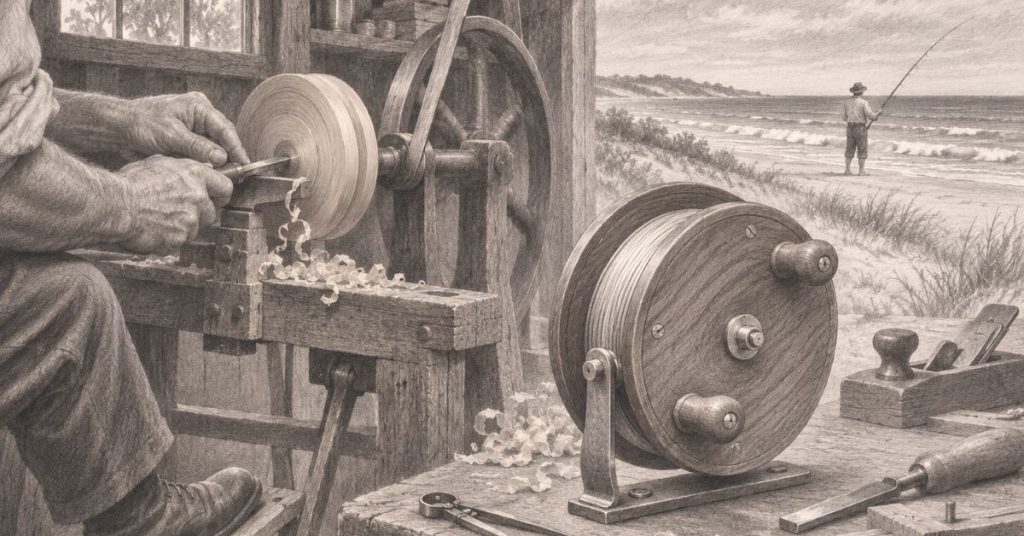
According to Queensland Museum, Alvey developed his reel design while working as a coachbuilder at the Ipswich Railway Workshops. His earliest commercial reels were made from silky oak using a foot-powered lathe.

The Australian Fishing Museum preserves a historical account that puts his initial production at about 20 reels a week, made in a workshop without electricity.

A Queensland Take on the Sidecast Reel

Alvey did not invent the sidecasting principle. Scottish reelmaker Peter Malloch had patented a sidecast reel in 1884. Alvey developed his own version of the technology and established an Australian manufacturing business around it.

Before casting, the angler turns the reel through a quarter-turn, allowing the line to unwind over the rim of a stationary spool. The reel is then returned to its winding position to retrieve the line.

This arrangement avoids the spool overrun associated with some rotating-spool reels. However, the Surf Casting and Angling Club of Western Australia explains that sidecasting introduces line twist, which anglers need to manage.

In an account published by the Australian Industry Group, Charles’s great-grandson Bruce Alvey described how contact between the fishing line and an angler’s index finger helped detect small bites. The manufacturer also warns that braided fishing line can cut fingers and recommends suitable finger protection.

Timber, Bakelite and the Brisbane Flood

Production methods evolved as the business expanded. According to Alvey’s corporate history, its earliest reels measured three or four inches (approximately 76 or 102 mm) in diameter. A kerosene-powered lathe later supplemented the original manufacturing equipment, and by 1936, Bakelite was being used to mould smaller spools.

During the Second World War, the factory’s machinery was adapted to produce vehicle and aircraft components. Charles died in 1945, the year reel production resumed.

His son Ken continued the business, followed by grandson Jack, who joined in 1946. Jack’s involvement in competitive fishing helped maintain contact with anglers whose suggestions informed changes to the reels.

The 1974 Brisbane flood severely damaged the St Lucia factory. According to the Australian Fishing Museum, members of the public and fishing clubs helped with the clean-up, allowing manufacturing to resume about two months later. The business relocated to larger premises at Carole Park in 1978.

Two Closure Announcements and a New Owner

By 2017, the business was struggling with declining sales and rising costs. Bruce Alvey, who ran the company alongside his brother Glenn, told ABC News that the longevity of its products limited repeat purchases. He also acknowledged changing fishing habits and insufficient sales to sustain operations.

Among the customers who visited the factory following the closure announcement was Stuart Peall, who recalled learning to fish with his late father using Alvey reels.

The business continued, with Con Athans becoming a majority shareholder in 2018. In 2022, material costs, supply difficulties and pandemic-related disruption prompted another closure announcement.

In December that year, ABC News reported that Australian investment company Gowings had acquired Alvey, allowing the business to continue.

Alvey Manufacturing Moves to New South Wales

Gowing Bros. Limited’s financial reporting for 2026 records the relocation of Alvey’s manufacturing facility from Darra in Queensland to Woolgoolga, near Coffs Harbour in New South Wales. Its 2026 annual report reports that the manufacturing move has been completed.

In August 2026, Gowings Pacific Trader published an account of the redesigned Direct and Drag reel ranges. Among the engineering decisions was the retention of an imperial fine thread in the drag mechanism, based on the company’s assessment of its operation.

The manufacturing equipment and materials have changed considerably since Charles Alvey began working with timber in St Lucia. The quarter-turn casting arrangement remains a recognisable feature of the Australian reel design he developed in 1920.

The French Paradox: Why Butter and Wine Never Solved France’s Heart-Health Mystery

By Jack Mercer – Rabbit Hole Fisherman

France has long offered an appealing dietary puzzle. Its cuisine is famous for butter, cheese, cream sauces and wine, yet French people have long enjoyed high life expectancy and, historically, comparatively low recorded death rates from coronary heart disease. For a while, one explanation became especially popular: perhaps a glass of red wine with dinner was protecting the French heart.

In This Story

The story began long before that idea made its way into newspaper headlines. It also turns out to be a useful warning about how easily a country’s eating habits can be reduced to a few famous foods.

In June 1992, French researchers Serge Renaud and Michel de Lorgeril published a short paper in The Lancet. Its title, Wine, alcohol, platelets, and the French paradox for coronary heart disease, was hardly designed for the supermarket checkout. The question behind it, however, was irresistible. Why did France appear to record fewer coronary deaths than might be expected from its consumption of saturated fat?

Renaud and de Lorgeril considered whether wine, and alcohol’s effects on blood platelets and clotting, could help explain the discrepancy. The idea arrived at a receptive moment. A rich meal and a glass of red wine were already familiar images of French life. Now there seemed to be a scientific reason to admire the combination.

There was a problem. The evidence did not show that drinking red wine made people live longer. It suggested a possible explanation for a pattern in population statistics. Those are very different things, although the distinction was easy to lose as the story travelled.

The country behind the postcard

Start with the longevity figures. France is a long-lived country. The OECD’s comparable 2024 figures put life expectancy at birth at about 83 years for both France and Australia. France’s national statistical agency, INSEE, reported higher life expectancy for women than men in its 2025 estimates, a gap familiar in many countries.

For Australians, the comparison is more interesting than the familiar claim that the French have discovered the secret of a long life. Two countries with different food cultures arrive at remarkably similar overall life expectancy. Neither figure tells us how much of that outcome is due to food. Medical care, smoking, income, working conditions, education and the risks people faced earlier in life all enter the calculation.

Even the phrase “French diet” is slippery. In Brittany and Normandy, butter has deep culinary roots. Around Provence and the Mediterranean coast, olive oil, vegetables, beans and fish occupy a more prominent place in traditional cooking. France has industrially produced snacks and ready meals as well as markets, bakeries and regional cheeses. A country of millions cannot be represented by one lunch table.

That is worth remembering when we picture the typical French meal. The baguette, the croissant and the cheese course are real enough. They are also the foods visitors remember, rather than a complete record of what people eat on an ordinary Tuesday.

The country’s own nutrition surveys offer a less romantic account. France’s ESTEBAN study, conducted in 2014–16, found that many adults fell short of dietary recommendations. Only about 13 per cent reached a daily fibre intake of at least 25 grams, according to the French public-health agency’s reporting. Salt and saturated fat were concerns, while wholegrains and legumes were not eaten as often as recommended.

This doesn’t make French food culture any less interesting. It makes the question more precise. France has achieved impressive longevity even though many French people, like Australians, could improve their diets.

How a scientific puzzle became a wine story

The original paradox concerned coronary heart disease, not all causes of death. Coronary disease develops when blood flow to the heart is restricted, often through atherosclerosis. Researchers had long examined associations between diets high in saturated fat, blood cholesterol and cardiovascular risk. The relatively low French coronary mortality figures seemed awkward beside that body of evidence.

Renaud and de Lorgeril looked at wine consumption as one possible piece of the explanation. Alcohol can affect blood clotting mechanisms, and the paper explored the relevance of those effects. But the move from a biological hypothesis to the popular belief that red wine is good for the heart required a leap the evidence could not justify.

Consider the difficulty of comparing drinkers with non-drinkers. Someone who has a glass of wine with a meal may also have a different income, diet, occupation, medical history or level of physical activity from someone who does not drink. Some older studies also grouped former drinkers, including people who had stopped because of illness, with lifelong abstainers. That can make moderate drinkers look healthier for reasons unrelated to alcohol.

There is a second difficulty. Even if alcohol were associated with a lower rate of one cardiovascular outcome in a particular study, it could raise the risk of other diseases. Alcohol causes several cancers. The World Health Organization has warned against treating any level of drinking as free of health risk. A possible advantage in one part of a health calculation cannot simply be taken as permission to ignore the rest.

So the appealing prescription — enjoy French food and wash it down with red wine for protection — never had the solid foundation its popularity suggested. Someone who doesn’t drink has no sound reason to start for the sake of their heart.

The explanation hiding in the past

Seven years after the Lancet paper, a different argument appeared in the British Medical Journal. Malcolm Law and Nicholas Wald asked whether researchers had been comparing the wrong periods of history.

Heart disease usually develops over decades. If the French had eaten less animal fat in earlier generations than people in some comparison countries, today’s coronary deaths might reflect yesterday’s diet rather than the food on today’s table. Law and Wald examined historical patterns and argued that a time lag could account for much of the apparent paradox.

They also discussed differences in the way countries classified and recorded causes of death. International comparisons can look precise on a chart while hiding different medical certification practices. If one country records a death as coronary disease and another uses a different category for a similar case, the resulting national rates can mislead.

Neither point proves that food had no influence on French health. The significance is that the original mystery did not necessarily require a protective ingredient peculiar to France. It could arise partly from history and measurement.

This is one of the more useful discoveries in the whole investigation. A population’s present diet and present life expectancy are not two halves of a simple equation. Both carry the marks of earlier decades. France’s experience is a reminder to be wary when a striking national statistic is explained with a single food or drink.

Butter, cheese and what a meal contains

The next temptation is to treat all dairy products alike. Butter is mainly milk fat. Cheese is a more complicated food: depending on the variety, it supplies protein and calcium alongside fat and salt. Fermentation, processing and the structure of the food may also matter when researchers study its effects. There is a growing body of research examining dairy foods as whole products rather than assuming that every gram of saturated fat arrives in the same nutritional package.

That is a worthwhile scientific question, but it should not be stretched into a claim that cheese cancels out cardiovascular risk. Nor does it follow that French longevity makes unlimited butter consumption harmless. Quantity, the rest of the diet and the foods displaced by dairy all matter.

France’s official food guidance is surprisingly familiar to Australian readers. It encourages more vegetables, fruit, legumes and wholegrains, recommends nuts and fish, and advises restraint with salt and added fats. It does not propose croissants as a daily health intervention or wine as medicine.

The unglamorous foods are easy to overlook in stories about French cuisine. Lentils, beans, vegetables and fruit seldom receive the attention lavished on a beautifully made pastry. Yet they are central to the advice given by French health authorities themselves.

The setting of a meal may matter as well. France has a strong cultural tradition of eating at recognised meal times and treating lunch or dinner as a social occasion. That is interesting in an age of hurried meals and continual snacking. But it would be a mistake to claim that sitting longer at the table has been proved to explain French life expectancy. Culture is difficult to separate from income, work patterns, family life and the food being eaten.

What the Australian comparison tells us

Put France beside Australia and the easy explanation begins to fall apart. Our food histories differ. Australia’s modern eating habits have been shaped by British traditions, migration from many countries, supermarkets, takeaway food and a growing range of fresh produce. France has its own mixture of regional traditions, industrial food and changing household habits. Yet the two countries recorded roughly the same life expectancy in the OECD’s 2024 comparison.

That does not mean diet is unimportant. There is substantial evidence that dietary patterns affect cardiovascular and other health risks. It means national longevity is the outcome of many influences acting together. A high life-expectancy figure cannot tell us which dish deserves the credit.

The comparison also raises a question that is often missed: how many of those years are spent in good health? Healthy life expectancy and age-specific mortality can help answer it, but they need comparable definitions and reporting years. An extra year of life and an extra year free of serious illness are not the same measure.

For an Australian household, the most practical lesson from France is modest. Enjoying food and making time for meals are worthwhile habits. A varied diet with vegetables, legumes, fruit, wholegrains and other nutritious foods has stronger support than the idea of a national miracle ingredient. Butter and cheese can be part of someone’s eating pattern without becoming the explanation for a country’s health statistics.

The original French paradox survives as a fascinating chapter in nutrition history. It brought serious scientists to an awkward question, encouraged new explanations and showed how readily a tentative hypothesis could turn into popular advice. The red-wine answer was wonderfully convenient. The research that followed was less accommodating.

A generation after that 1992 paper, France still has its butter, cheese, wine and long lives. What it has not supplied is proof that one indulgence protects against the others. The better story lies in the years of argument over why the statistics looked so surprising in the first place.

Editor’s note: Life expectancy is not evidence of dietary causation. The French paradox originally concerned coronary mortality, not overall longevity. All historical hypotheses are attributed to their researchers; the story makes no recommendation to consume alcohol for health.

David Bowie Berlin Wall Story: The Disputed Kiss Behind Heroes

By Jack Mercer – Rabbit Hole Fisherman

Recorded in West Berlin in 1977, Heroes became one of David Bowie’s defining songs.
The famous kiss story remains contested, but the record’s sound and legacy still stand.

In This Story

Berlin and Bowie

In 1977, David Bowie recorded Heroes at Hansa Studios in West Berlin. The studio sat near the Berlin Wall. The city shaped the session. One familiar story says Bowie saw Tony Visconti and Antonia Maass kiss nearby. That account remains disputed.
Still, the song carries Berlin’s atmosphere and Bowie’s ambition. The dispute never removed the record’s power.

By the mid-1970s, Bowie wanted cleaner habits and a different sound. He also wanted distance from Los Angeles. Berlin offered both privacy and tension. He worked there with Iggy Pop and Brian Eno. That period reshaped his career. The Berlin years became one of his most important creative stretches. He wanted a harder edge and less excess.

The Hansa Studios sessions

Heroes belonged to the Berlin Trilogy. It was the only one recorded entirely in Berlin. Hansa’s location mattered. The room was a former dance hall. Its long reverb changed the record’s feel. The building’s mood mattered as much as its acoustics. The wall loomed over the studio window.

The band built the track from ideas, not completed songs. Carlos Alomar played guitar.
George Murray played bass. Dennis Davis played drums. Robert Fripp later added the soaring lines. Brian Eno added texture too. Fripp’s guitar seems to hover above the rhythm. The result sounds controlled and open at once. It keeps unfolding as it plays.

The sound of Heroes

Tony Visconti shaped Bowie’s vocal sound with three microphones. He placed them at different distances. Noise gates opened as Bowie sang louder. The close mic caught the quiet lines. The distant mics added room echo. The performance grew wider as the song climbed. Visconti wanted the room to breathe with Bowie. The technique matched the song’s emotional rise.

The disputed kiss story

Visconti said Bowie left him alone with Maass for a walk. He said they kissed near the Wall. Maass later challenged the timeline. The safest reading treats the kiss as recollection, not fact. The story survives because it fits the music. That uncertainty does not weaken the song. It strengthens the legend around it. The chronology stays unclear, but the record stays compelling.

Chart history and legacy

On release, Heroes reached No. 24 on the UK singles chart. The album reached No. 3.
The single later gained far greater cultural weight. Its endurance came from emotional force, not immediate sales. Listeners kept returning to it. Radio programmers did not decide its long-term importance.

Bowie returns to Berlin

In 1987, Bowie returned to Berlin for an outdoor concert near the Reichstag. East Berliners gathered on the other side of the Wall. Police tried to hold them back.
Contemporary reports described tension and confrontation. The Washington Post reported clashes near the border. Bowie later called the night deeply moving. That concert linked the song to a city in flux. The moment added another layer to the song’s history.

Heroes endures because it joins memory, myth and performance. The disputed kiss matters. But the recording’s sound matters more. The song still feels larger than its parts.
Bowie and his collaborators built a track that keeps opening outward. That is why it remains one of his defining recordings. The music still feels urgent, intimate and vast.