




By Jack Mercer – Rabbit Hole Fisherman
Almost everything we do online depends on cables on the ocean floor. Here is how they got there, who owns them and what happens when they break.
Off the Australian coast, a cable no thicker than a garden hose disappears beneath the sea. It may run for thousands of kilometres before reaching another continent.
In This Story
- The message that took sixteen hours
- How a cable became the internet
- How much cable is out there?
- What really breaks them?
- Two times the seabed made the news
- How do you repair a cable on the ocean floor?
- Why not use satellites instead?
- Who owns the ocean’s information highways?
- Australia’s underwater connections
- The next generation
Inside are glass fibres carrying video calls, banking instructions, emails and data between the world’s data centres.
The internet may feel wireless. Between continents, it is mostly wired.
Submarine fibre-optic cables carry most intercontinental data traffic. Satellites are essential in remote areas and in emergencies, but they cannot yet match the capacity of the global undersea network.
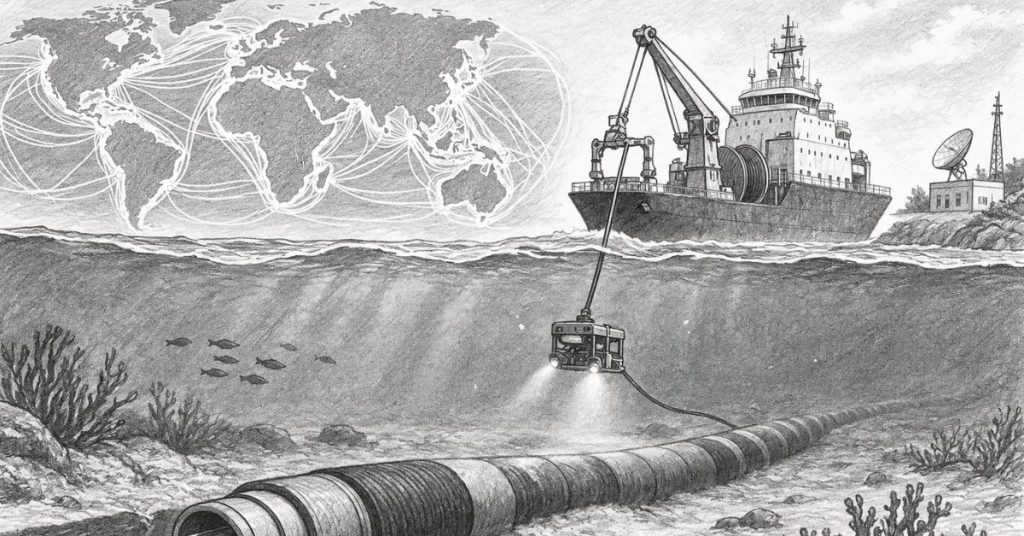
What is often forgotten is how physical the system remains. Hundreds of cable systems cross the oceans. They must survive deep water, shifting seabeds, fishing gear, ship anchors and earthquakes. When something goes wrong, a specialist vessel may have to recover the cable and splice it back together.
This is the story of how a Victorian engineering gamble became one of the foundations of modern life.
The message that took sixteen hours
In the 19th century, news crossing the Atlantic travelled by ship. Governments, merchants and newspapers waited days or weeks for information that now arrives in seconds.
The electric telegraph transformed communications on land, but the Atlantic remained a barrier. A cable had to be manufactured, loaded aboard ships and laid across a seabed whose contours were still only partly known.
Cyrus West Field, an American businessman, became one of the key organisers of the effort. After several attempts, a telegraph cable connected Ireland and Newfoundland in August 1858. Queen Victoria sent a message to US President James Buchanan. Transmission took around 16 hours — slow by modern standards, fast by the standards of the day.
The cable failed within weeks.
A durable transatlantic connection was established in 1866. It changed the practical meaning of distance. Diplomatic instructions, financial news and commercial information could move between continents without waiting for a ship.
The technology was far less capable than modern fibre optics, but the central idea has endured: if information needs to cross an ocean reliably and at scale, a physical connection works.
How a cable became the internet
Early submarine cables carried telegraph signals through copper conductors. Later systems carried telephone calls. Modern cables use optical fibres — hair-thin strands of glass that guide pulses of light.
An undersea cable is more than a bundle of glass. It has protective layers, and long-distance systems use powered optical repeaters at intervals to maintain signal strength. Near shore, where anchors and fishing gear pose greater danger, cables can be armoured and buried beneath the seabed. In deep water, many lie directly on the ocean floor.
The amount of information they carry is hard to picture. Modern systems can transmit many terabits per second, depending on cable design and transmission equipment. A terabit is one trillion bits.
Even so, the cable remains a physical object. The electronics may be advanced, but the ocean has not become any gentler.
How much cable is out there?
TeleGeography maintains a widely used map and database of submarine cable systems. Its 2026 map shows hundreds of systems worldwide, including active and planned projects. That distinction matters: a planned route is not the same as a cable already carrying traffic.
The International Cable Protection Committee estimates the global telecommunications cable network extended to roughly 1.7 million kilometres by 2025. Such figures change as new systems are installed and older ones are retired.
The network is not evenly spread. Some countries have multiple separate routes and landing stations. Others depend on only a few connections. Two places can both be connected and face very different consequences when a cable fails.
What really breaks them?
A damaged cable can sound like the opening of an espionage thriller. In practice, the most common causes are more ordinary.
Industry data points to fishing activity and ship anchors as major causes of cable faults. ICPC publications on cable faults Natural hazards, including earthquakes and underwater landslides, also cause damage. Technical faults occur as well.
The International Cable Protection Committee commonly reports about 150 to 200 cable faults globally a year, although counts vary by period and dataset. That does not mean the global internet fails hundreds of times. Operators usually have alternative routes and can reroute traffic while repairs are organised.
What matters is where a failure occurs, which systems share the affected area and how much spare capacity exists elsewhere.
Two times the seabed made the news
In December 2006, a powerful earthquake south of Taiwan damaged several submarine cables. Communications traffic across parts of Asia was disrupted, and repairs took time because multiple systems had been affected. The event showed how a natural disaster can hit connections that look separate on a map but run through the same vulnerable corridor.
Tonga suffered a different disaster in January 2022. The Hunga Tonga–Hunga Ha’apai volcanic eruption and tsunami damaged the country’s international submarine cable, severely disrupting communications. Restoration required specialist repair work in difficult conditions.
The lesson is that cable resilience is not just about the number of routes on a map. Geography matters. So do repair arrangements, landing stations and alternative communications.
How do you repair a cable on the ocean floor?
First, engineers identify the approximate location of the fault using measurements from the cable system. A specialist repair ship then travels to the area.
Depending on depth, seabed conditions and the nature of the damage, the crew may use grapnels or remotely operated equipment to locate and recover the cable. A damaged section is cut away, replacement cable is spliced in and the repaired system is tested. The cable is then returned to the seabed and, where appropriate, reburied.
It is painstaking work. Repairs can be delayed by storms, distance, vessel availability and permissions to operate in particular waters. Where several cables are damaged at once, the available repair fleet may face competing demands.
A cable failure in a heavily connected market may barely register with consumers. For an isolated island, the wait for repairs can disrupt business, education, government services and family communications.
Why not use satellites instead?
Satellite broadband has transformed connectivity for remote communities, vessels and aircraft. It can also provide a useful backup when other infrastructure fails.
But it is not a simple substitute for submarine fibre.
Major intercontinental routes require vast capacity. Fibre-optic cables are well suited to moving that volume between fixed points. Satellites face limits in spectrum, capacity, equipment and the economics of serving large numbers of users.
That is why the spread of low-Earth-orbit satellite services has not stopped companies investing in submarine cables. The technologies complement each other. One offers reach and redundancy where the other is hard to install; neither makes the other irrelevant.
Who owns the ocean’s information highways?
Historically, telecommunications carriers built many international cables through consortia. They shared construction costs and gained rights to use the resulting capacity.
Today the picture includes some of the world’s biggest technology companies. Google, Meta, Microsoft and Amazon have invested in submarine cable infrastructure, sometimes through consortia and sometimes through projects tied closely to their own networks.
There is a practical reason. Companies running cloud services, search engines, social platforms and data centres need to move huge volumes of data between continents.
Ownership should not be confused with control of communications content. Nor does a cable owner control the whole internet. But the shift shows how much of the digital economy depends on physical assets financed by the companies whose services people use every day.
Australia’s underwater connections
For Australia, submarine cables are not a technical curiosity. They are essential links to overseas markets, cloud infrastructure and international communications.
International cables land at sites around the country, with major concentrations near Sydney and Perth. The Australian Communications and Media Authority publishes information on landing locations and regulates declared submarine cable protection zones.
These zones restrict activities that could damage infrastructure. The rules can apply to anchoring, trawling, dredging and other seabed-disturbing work. Their purpose is simple: prevent routine maritime activity from damaging cables that are difficult and expensive to repair.
The harder question is how resilient Australia’s international connectivity would be under different failure scenarios.
A simple count of cables is not enough. Engineers have to consider whether routes are geographically separate, whether they share landing facilities, how much capacity can be shifted elsewhere and how quickly repairs could be completed.
A fault on one route is very different from a major event affecting several cables in the same corridor. The answer also depends on the services involved. Some data can be cached or processed locally; other services depend on continuous international connections.
It would be misleading to say one broken cable could simply switch off Australia. It would also be complacent to assume multiple cables eliminate every risk.
The next generation
Demand for international capacity continues to grow. Cloud computing, video, data-centre traffic and artificial intelligence are all driving the expansion and upgrade of global networks.
Engineers are developing higher-capacity optical systems, adding new routes and finding ways to use existing fibres more efficiently. Operators also have incentives to diversify routes and reduce the impact of failures.
But the physical problem has not gone away. A cable that can carry far more data than its predecessor can still be caught by fishing gear or damaged by a submarine landslide.
Progress means not only carrying more information, but making sure it keeps flowing when something breaks.
The most physical part of a digital world
It is easy to describe the internet as invisible, floating around us. We connect over Wi-Fi, store documents in the cloud and watch events on the other side of the planet as they happen.
But much of that experience rests on an old idea: build a line from one place to another and send information along it.
The materials have changed since the first transatlantic telegraph cable failed in 1858. Copper has given way to glass. Messages that once took hours now travel in fractions of a second. The volume of information is far beyond anything 19th-century engineers could have imagined.
Yet a great deal still depends on ships, cables, skilled crews and the ability to work in difficult conditions far out at sea.
Somewhere beneath the waves, the modern world is held together by strands of glass.
And when one breaks, somebody still has to go and fix it.