




By Jack Mercer – Rabbit Hole Fisherman
Salted, cultured, spreadable, grass-fed: the dairy cabinet offers plenty of choice. Understanding a few differences makes it easier to decide what belongs in your kitchen.
A cold block of butter and a slice of soft bread can be an awkward combination. The knife scrapes off a stubborn curl, the bread tears, and the tub promising easy spreading suddenly looks attractive.
In This Story
- Start with the ingredients
- Salted or unsalted?
- Why does one butter spread more easily?
- What does “cultured” mean?
- European-style: a little more fat
- Grass-fed and golden
- Ghee has a different job
- Why the price feels so different
- Is the dearer block worth it?
- Keep the health claim modest
- Getting it right at home
But turn that tub around. Does it contain cream and salt, or butter blended with vegetable oil? Nearby might sit cultured butter, European-style butter and a gold-wrapped block announcing that its cows were grass-fed.
They may share a shelf, but the words describe different things: ingredients, production methods, farming practices and texture. Some products combine several of those descriptions.
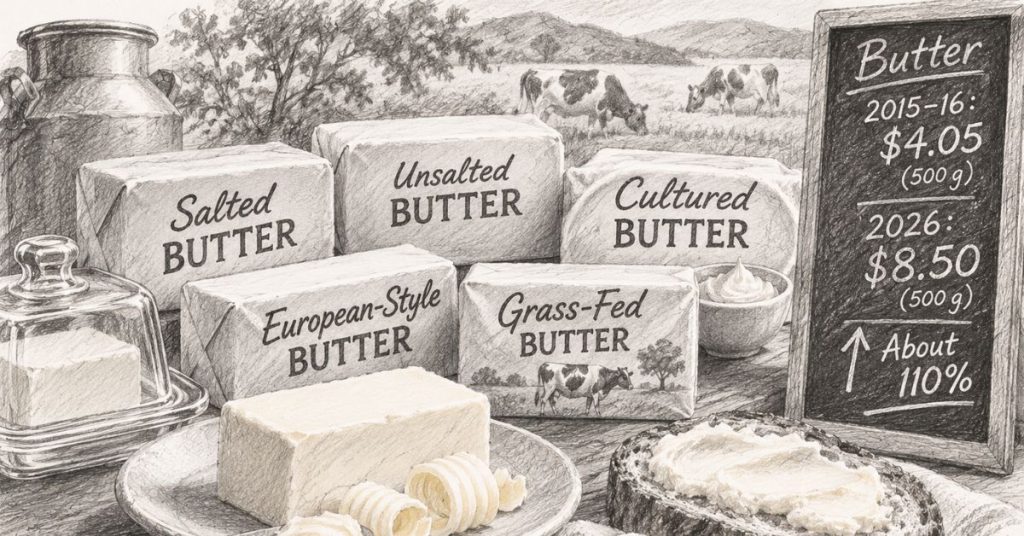
With a standard 500g block now observed at $8–$8.50 in Brisbane, there is good reason to understand what we are paying for. The first question is the simplest: what counts as butter?
Start with the ingredients
Australia’s food standard gives butter a specific meaning. It is derived exclusively from milk and milk products, with permitted additions including water, salt and certain cultures. Food sold as butter must contain at least 80 per cent milk fat.
That leaves room for water and small amounts of other milk components. A block of butter is not a block of pure fat.
Its structure is an emulsion: tiny droplets of water held within a continuous fatty phase. Cream is churned to bring its fat together, and the liquid buttermilk is drained away.
The familiar ingredients list can be very short: cream, with salt for a salted version. Cultured butter adds another element, but it remains dairy butter.
An olive-oil spread is a different product. So is a butter blend containing vegetable oil. Either may suit someone’s taste or purpose; neither belongs in a straightforward price comparison between ordinary blocks of dairy butter.
Salted or unsalted?
For the breakfast table, this is largely a flavour decision. Salted butter supplies its own seasoning, which can be particularly welcome on toast or a baked potato.
Unsalted butter gives the cook control over how much salt enters a dish. That is useful when making a sauce or following a baking recipe with a separately measured quantity of salt.
Salt levels vary between products, so the nutrition panel is more informative than assuming every salted block tastes the same.
There is no need to treat an unsalted block as a specialist ingredient reserved for ambitious baking. It is simply butter without added salt. Equally, salted butter can work in baking when the recipe allows for it.
For a reliable result, start with the type the recipe specifies. A recipe tested with unsalted butter is easier to reproduce when you use it.
Why does one butter spread more easily?
“Spreadable” tells you about convenience. It does not, on its own, tell you the ingredients.
One route is to combine dairy butter with vegetable oil. Western Star’s Original Soft, for example, lists cream, vegetable oil and other ingredients. Its Cultured Gold product is a blend of cultured butter and canola oil.
Another route produces a spreadable dairy butter without added oil. Mainland’s ButterSoft describes its product as triple-churned cream and salt.
Those examples show why the tub’s shape is no guide to its contents. A tub can contain pure butter; a familiar butter brand can also sell blends.
Read the product description and ingredients together. If vegetable oil appears, you are buying a blend rather than a conventional dairy butter block. That matters when comparing price, flavour and cooking performance.
For sandwiches, easy spreading may be the feature you value most. For a recipe calling for a weighed piece of firm butter, check before assuming the sandwich spread is interchangeable.
What does “cultured” mean?
Cultured butter starts with cream treated with selected bacteria that develop acidity and flavour. Fermentation gives it a tangier character than an ordinary uncultured butter.
“Sweet cream” butter, by contrast, refers to cream that has not undergone that deliberate souring process. It does not mean sugar has been added.
The difference is easiest to explore with something plain. Try a little of each on the same bread, at a similar temperature, without jam or another strong topping. You may enjoy the cultured butter’s tang, or prefer the milder alternative.
Cultured does not automatically mean unsalted. Look for both descriptions if that distinction matters to you.
Nor does a cultured label, by itself, establish a particular digestive benefit. Its clearest promise to the shopper is a production method and a different flavour.
European-style: a little more fat
European-style butter commonly has a higher fat content than a basic 80 per cent butter. An example is Land O’Lakes’ European-style product, which contains 82 per cent milk fat.
That sounds like a small difference. Across a recipe using substantial butter, however, a changed balance of fat and water can affect texture.
King Arthur Baking’s tests illustrate the point: changing to a higher-fat European-style butter altered the results in shortbread and scones. A more expensive butter does not automatically improve every recipe.
For eating on bread, the decision can be straightforward: do you like its taste and texture enough to pay the extra?
For baking, use the recipe’s guidance before upgrading the ingredient. “European-style” describes a style; check the country-of-origin information separately if where it was made matters to you.
Grass-fed and golden
The cow’s diet can influence butter’s colour and composition. Research comparing pasture-based and indoor feeding systems found differences in the resulting butters, including higher beta-carotene in pasture-derived butter. Beta-carotene contributes yellow colour.
That helps explain why two genuine dairy butters need not be the same shade. Colour alone is an incomplete way to judge quality.
“Grass-fed” concerns how the milk was produced. It does not tell you whether the finished butter is salted, cultured or easy to spread. A shopper interested in the claim should look for the producer’s explanation of what it means.
It is also separate from the question of how much butter to eat. A farming claim does not remove the need to consider saturated fat.
Ghee has a different job
Clarified butter and ghee concentrate butterfat by removing water and milk solids. They are useful cooking fats, particularly where ordinary butter’s milk solids would brown or burn.
Ghee generally undergoes further cooking that develops a characteristic toasted flavour. Methods and flavour vary between products.
These fats belong in the discussion because they begin with butter, but they do a different job from a cold block intended for toast or baking.
They also belong outside the ordinary butter price comparison. Paying for a concentrated cooking fat is a different purchase from buying a standard 500g block.
Why the price feels so different
The Brisbane observation supplied for this article is $8–$8.50 for a standard 500g salted or unsalted block. That is a shopping observation in November 2026, rather than a survey of every store or brand.
There is useful historical context. Dairy Australia’s In Focus 2016 report recorded a national supermarket average of $8.35 a kilogram for the butter category in 2015–16. That is about $4.18 for an equivalent 500g weight.
The observed $8–$8.50 range is roughly 92–104 per cent above that historical equivalent, before adjusting for inflation.
The comparison needs its limits stated. The older figure combines butter purchases across brands and pack sizes nationally; the newer figure is a local observation of standard blocks. It is not a matched-product price history or a measure of Brisbane butter inflation.
The report’s separate 500g dairy-spreads table includes more than butter, so it cannot supply a clean historical butter-block price.
Butter also participates in an international market. Dairy Australia reported that imports accounted for 39 per cent of Australia’s butter market by volume in 2024–25. Local shoppers are buying a product connected to overseas supply and trade as well as Australian production.
That context does not establish why a particular supermarket changed a particular price.
Is the dearer block worth it?
The useful comparison starts with the price per 100g. A small premium pack can look affordable beside a large block while costing considerably more for the same weight.
Next, ask what you want from it. A distinctive cultured butter might earn its place on a loaf of good bread. An ordinary block may do everything you need for weekday cooking.
A simple tasting can be more useful than choosing by wrapper. Serve small, unlabelled samples with plain bread and decide which you prefer before revealing their prices.
The result may justify a favourite premium butter, or leave you happy with the cheaper one. Either outcome gives you a reason for the purchase beyond the packaging.
Keep the health claim modest
Butter is rich in saturated fat. The Heart Foundation advises eating it only sometimes and in small amounts, and recommends favouring unsaturated fats.
Salted versus unsalted addresses added salt. Cultured versus uncultured addresses fermentation and flavour. Neither distinction, by itself, turns butter into a food to eat without restraint.
Reading the saturated-fat and sodium figures per 100g helps keep comparisons consistent. Serving sizes printed on different packs can otherwise make the numbers harder to compare.
Getting it right at home
For baking, handling can matter as much as the variety. Cold butter helps form distinct layers in pastry; softened butter incorporates differently. Melted butter is different again.
A Brisbane kitchen also gives “room temperature” a seasonal meaning. Follow the texture the recipe needs rather than assuming butter left on the bench will reach the right condition.
Keep butter refrigerated and protected from air and other food odours, following the pack’s storage instructions. Cut off what you need for serving or cooking.
On the next shopping trip, look at three things: the product name, the ingredients and the unit price. Those few seconds will tell you more than the colour of the foil.
Then choose for the job in front of you: spreading, seasoning, baking or enjoying a particular flavour. The butter cabinet becomes easier to navigate once you know which difference you are paying for.