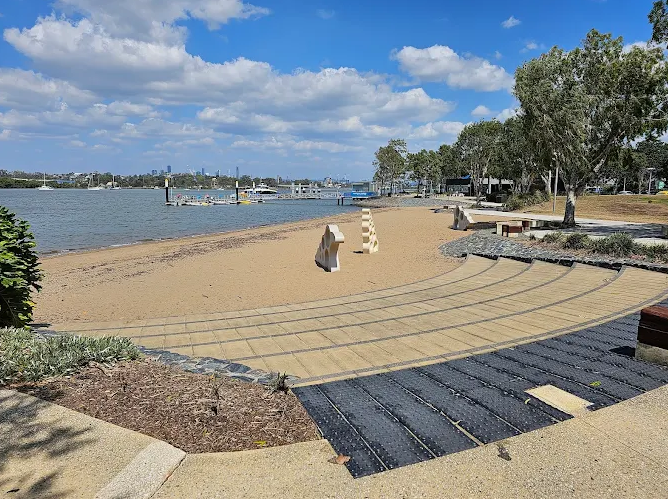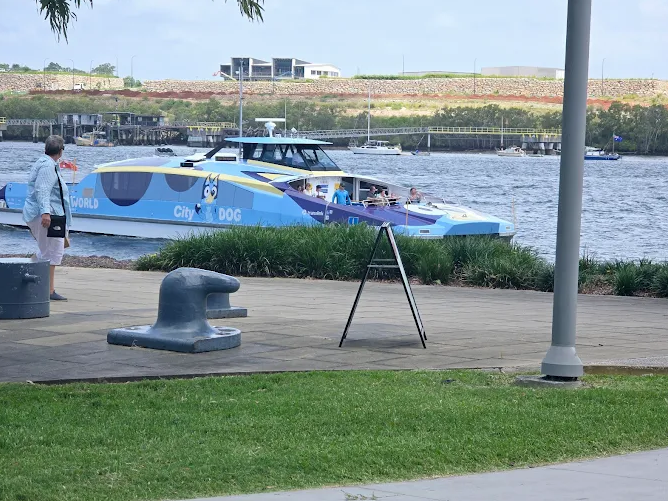




Brisbane’s Northshore Hamilton Recreation Hub is among eight river pontoons earmarked for new uses, as plans advance to welcome water taxis, tour boats, and other tourism ventures to the city’s waterways.
The move aims to activate key riverfront spots with faster, more flexible transport options and fresh leisure opportunities in Brisbane. Currently used mainly for short-term recreation such as kayaking or drop-offs, the hubs including the one in Hamilton, are now being reviewed for potential transformation into busier pick-up and drop-off points.
Photo credit: Larry Chand/Google Maps
Northshore Hamilton is considered a standout site, with its proximity to dining, events and cruise ship arrivals, making it a prime candidate for future water taxi and tour services. Advocates believe the shift could boost visitor numbers and provide an “express-style” alternative to the slower CityCats, which stop at nearly two dozen terminals.
The plan also includes other hubs at Murarrie, Kingsford Smith Drive, New Farm Park, the City Botanic Gardens, West End, Dutton Park and Riverhills. Together, they could open the river to more tourism and hospitality businesses, alongside new infrastructure and a licensing system designed to encourage private investment.
Photo credit: Maria Roscida Mortimer/Google Maps
If realised, residents and visitors alike would gain greater choice in how they travel and explore Brisbane’s river precincts. Supporters see it as a way of creating more to see and do along the river, while critics question whether public assets should be leased to private operators.
The idea of water taxis on the Brisbane River has surfaced in earlier strategies dating back to 2013, but the latest announcement signals a fresh push to turn river hubs like Northshore Hamilton into gateways for transport, dining cruises and adventure tours.
A versatile public recreation hub offering direct Brisbane River access for various watercraft has been provided to the Hamilton community as part of a major local road project.
The Kingsford Smith Drive Recreation Hub opened to the public in early 2020. It was built as a component of the significant $650 million upgrade to Kingsford Smith Drive, a major infrastructure project for Brisbane. The road upgrade project, including the recreation hub, was completed in late 2020 and delivered under budget.
This facility is part of Council’s wider River Access Network, which aims to improve how residents and visitors can use and enjoy the Brisbane River. Importantly, the hub connects directly to the Lores Bonney Riverwalk, a 1.2-kilometre path for pedestrians and cyclists created during the roadworks, providing linked-up recreational opportunities along the riverfront. Nearby redeveloped areas such as Bretts Wharf Plaza and Cameron Rocks Reserve also offer additional public spaces for the community.
Design and Construction
Photo Credit: Google Map
The Jetty Specialists / Marine Structures designed and constructed the hub’s pontoons. The facility is designed to last 50 years and is built using durable materials like aluminium for the pontoons and strong mooring and guide piles.
Key considerations in the design included ensuring it complied with standards for disabled access and building it to withstand high flood levels. The hub features the Council’s distinct blue, white, and yellow branding colours, along with signage and lighting. It also includes different deck heights above the water, known as freeboard heights, with some low zones specifically suited for easy launching of passive craft like kayaks and canoes.
The recreation hub caters to a broad range of users. It provides access to non-motorised watercraft such as kayaks, canoes, and stand-up paddleboards. Owners of motorised recreational boats can also use the facility for short-term mooring, generally for up to two hours unless signs indicate otherwise, making it convenient for quick stops.
The design also allows for potential water taxi pick-ups and drop-offs. Furthermore, parts of the facility, likely the commercial pontoon section, can accommodate larger vessels, including tour boats like the “Lady Brisbane,” with a capacity of up to 300 tonnes displacement. The main purpose is to be a convenient point for short-term use, allowing various boaties and paddlers to get on and off the water easily.
The Brisbane River catchment carries over 40 per cent of the run-off from the Moreton Bay region and flood mitigation efforts remain a primary concern. Over the centuries, climatic and environmental changes have had catastrophic consequences to the river flow, impacting Brisbane’s suburbs, including Hamilton.
The 2022 Flood
In February 2022, the Brisbane River breached its banks and reclaimed its floodplain, peaking at 3.9 metres, inundating roads, buildings and structures in what will go down in Brisbane’s watery history as another significant instance of flooding.
More than 15,000 homes have been flooded whilst 54,000 households had no power. Though this was lower than the 4.46 metres experienced during the 2011 flooding, more suburbs experienced the worst flooding.
Photo Credit: Trucking Crane Trucks/Facebook
Schools and roads were closed while a stay-home order was issued whilst damage assessment took place. Disaster assistance and recovery programs were also set in place to help the flood victims.
Photo Credit: Chris Croft/Facebook
Here’s a round-up of the worst Brisbane River floods that have affected Hamilton and the suburbs around what we know today as Brisbane.
March 1864
The 1864 flood was accompanied by a gale of wind so violent, it destroyed even the best-protected houses. Umbrellas were useless outdoors because of the wind. Sections near the Brisbane river had more than six inches of rain until the water began to rise, leaving many residents stranded. Some locals were able to abandon their house before it went underwater.
March 1870
Low-lying areas on the stretch of Eagle Farm to Breakfast Creek were covered in several inches of water due to great rains. All creeks in the district had been flooded and roads disappeared as the river swelled.
Disastrous floods rising to 23 feet and nine inches submerged houses and establishments near the Brisbane River. Victoria bridge in the north was completely destroyed.
Photo Credit: State Library of Queensland
This was the most severe flood ever experienced thus far with three floodings occurring within days of each other, putting Brisbane at a standstill.
Photo Credit: State Library of Queensland
March 1908
Excessive rains for four days suspended traffic and damaged crops. Half of Pinkeba was underwater for days as well, spilling over to nearby sites like Hamilton. But while the water prevailed, it did not reach as high as the previous floods.
February 1931
Brisbane had its first disastrous flood after 23 years. More than a thousand homes in the Breakfast Creek area were submerged. City wharves were underwater as well as the water reached South Brisbane. Serious damages were noted in Milton, Oxley, Rocklea, Fairfield, and Sherwood districts.
The floodwaters were highest since February 1931, resulting in flooding in Brisbane’s lower catchment. River debris flowed through the towns in great quantities.
January 1974
Photo Credit: Queensland Government
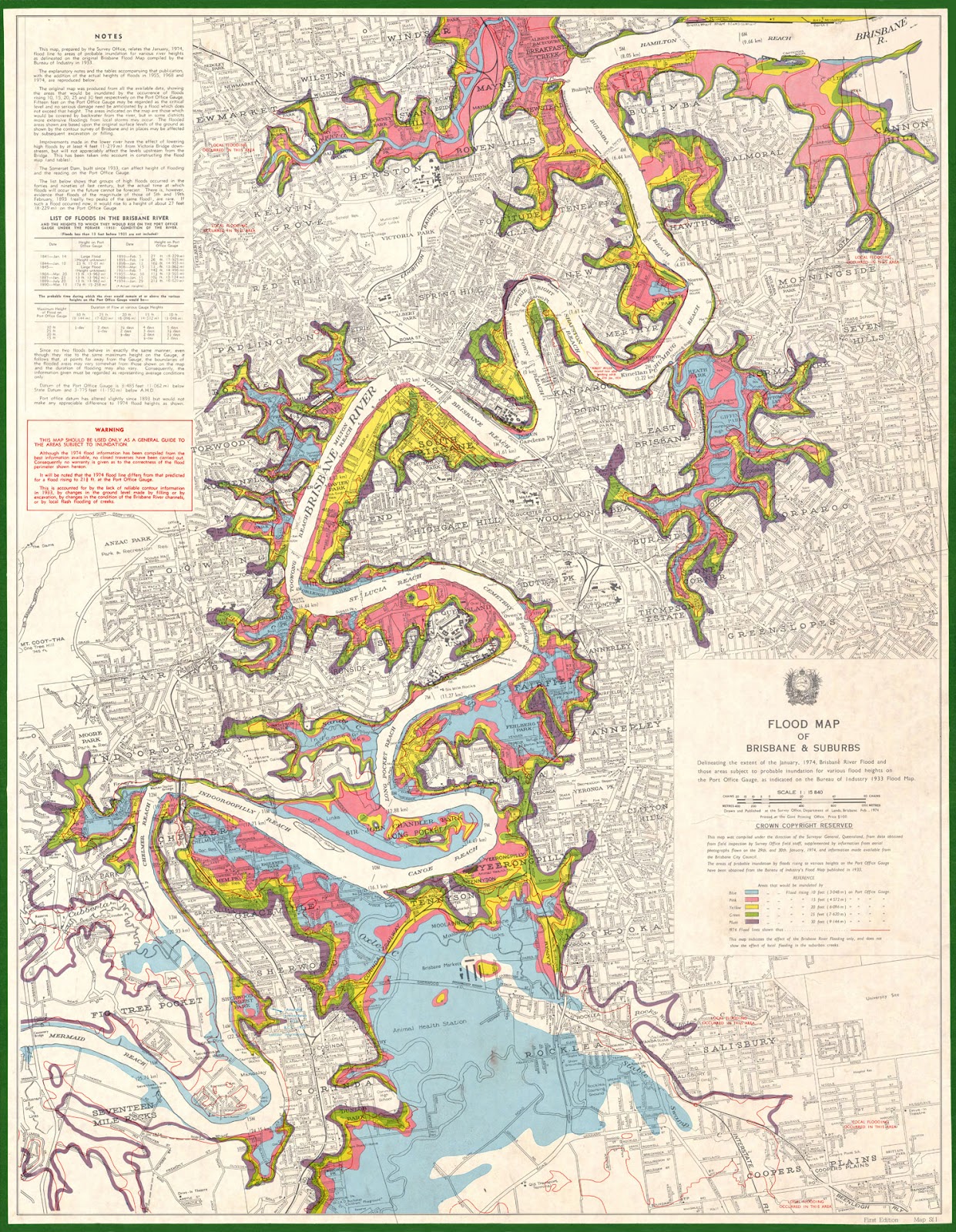
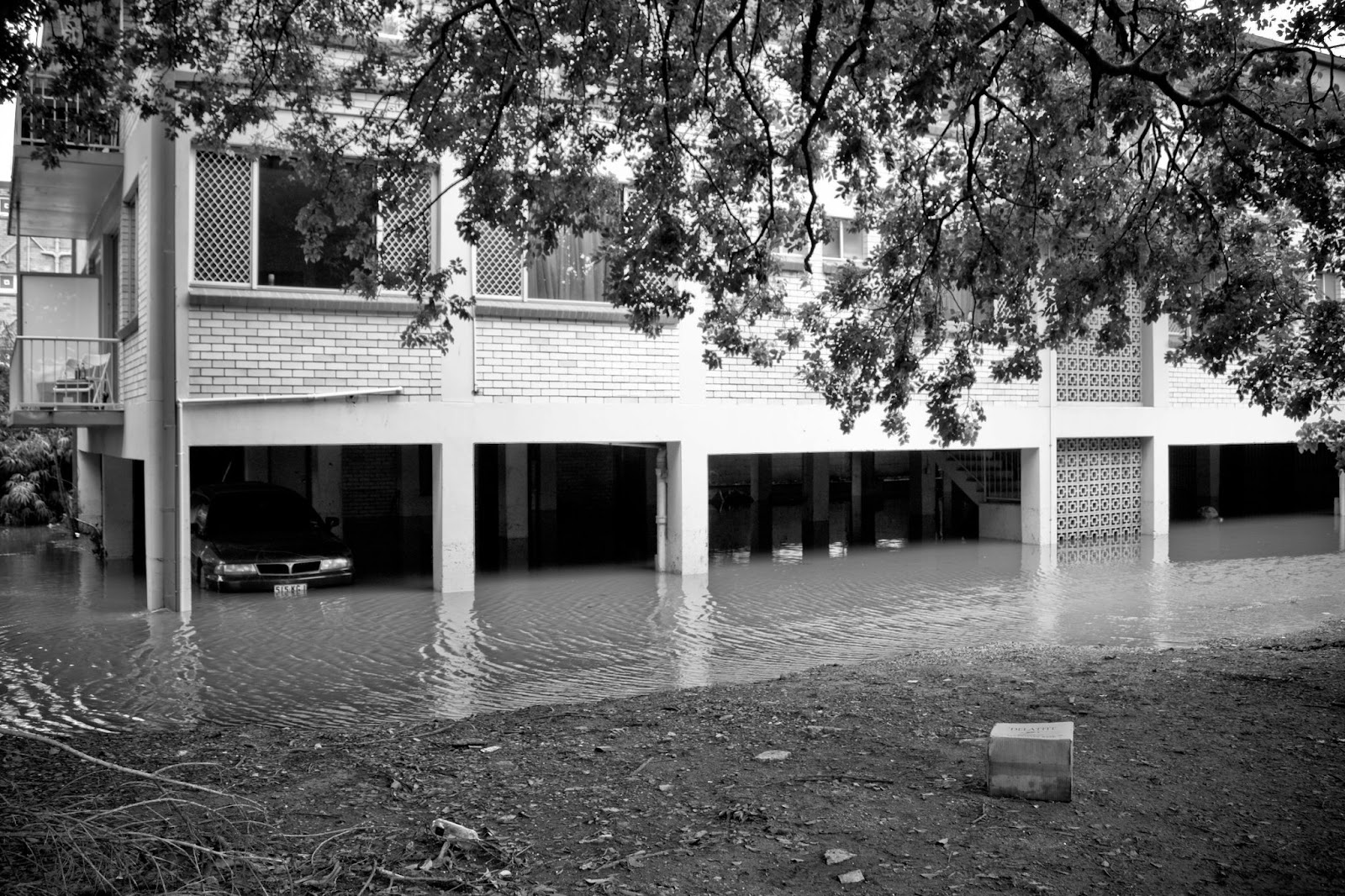
In the 1974 flood, the Brisbane River was at its highest level since the flooding in 1893. More than 8,000 homes were destroyed.
Photo Credit: State Library of Queensland
Businesses suffered many losses, which were estimated to be at $68 million by the Insurance Council of Australia.
Photo Credit: Lost Brisbane/Facebook
January 2011
Extreme flash floods brought on major flooding in Brisbane, affecting more than 200,000 people, killing 33, and leaving estimated damage of $1 billion. This was the largest flood height produced since 1974, with the Brisbane River experiencing seven major flood peaks.
Photo Credit: Norris Chau/FacebookPhoto Credit: Sue Mansfield/Facebook
After 2011, property values of suburbs across Brisbane fell between 6.1 to 18 per cent. Despite the recent floods, property experts are confident that house prices will recover quickly and riverside locations like Hamilton will continue to attract demand.
Place of the Water Rat
Historically, the Turrbal people have experienced numerous instances of flooding in this river that they refer to as called ‘Maiwar.’ They also referred to the south end of the peninsula as ‘Kurilpa’ or ‘place of the water rat.’
Despite the destruction brought about by the periodic flooding, the wetlands and creeks leading to and around the Brisbane River also gave rise to fertile land around them, providing food and sustenance to the local Jagara and Turrbal tribes for centuries.
Today, despite the watery history, these areas are among the most highly sought after, with its river views and prime locations for houses in desirable suburbs like Hamilton, Ascot, Clayfield, Bulimba, Kangaroo Point, Teneriffe, and others.
With their permanent home in Breakfast Creek, Albion still under construction, GoBoat has launched a fleet of new eco-friendly picnic boats stationed at the Dockside Marina in Kangaroo Point.
Though construction isn’t finished for their upcoming permanent venue along Breakfast Creek in Albion, GoBoat has opened a limited-time pop-up venue at Dockside Marina in Kangaroo Point to give Queensland a taste of what the vessels this Danish company has to offer.
“We’ve been so blown away by all the emails, calls & messages from Brisbanites wanting to celebrate occasions or organise get-togethers on our boats that we couldn’t let you wait any longer!” the company announced.
Each boat stands 5.5 metres long, fashioned from recycled materials such as wood and bottles. Shading will be installed to shield those aboard from the elements.
The boats are eco-friendly and quiet, and the fact that they are powered by German electric engines means they do not produce any smog, nor do they make loud noises. This, combined with the fact that boating licenses won’t be required to operate them, makes them suitable for public use.
By July 2021, GoBoat will have four additional boats to augment the present fleet.
Those interested in renting the boats can do so for the price of $109 an hour, $189 for two hours, and $229 for three hours. People will be able to bring their own food, beer, and even pets for the ride. Up to eight passengers will be able to fit in a single vessel, making them ideal for group picnics.
Though the official launch of GoBoat Brisbane in their permanent site at Breakfast Creek, Albion has yet to be announced, their pop-up placeholder is located at Dockside Marina at 44 Ferry St, Kangaroo Point.
For more information, visit their website here. Follow their social media accounts on Facebook and Instagram for the latest updates and announcements concerning the upcoming picnic boats.
A ferry terminal will be built at Howard Smith Wharves, linking the Hamilton Northshore and UQ St Lucia terminals to the much-anticipated riverfront destination.
Brisbane City Council made the announcement as Howard Smith Wharves closes in on the opening date. The ferry terminal will be jointly funded by Howard Smith Wharves and the council. Howard Smith Wharves will contribute $3 million to the $12-million project.
Proposed site of the Howard Smith Wharves ferry terminal. (Photo credit: Brisbane City Council)
Deputy Mayor Adrian Schrinner believes that building a terminal at Howard Smith Wharves makes perfect sense. After a $110-million revitalisation effort, Howard Smith Wharves is poised to become a world-class lifestyle and public entertainment riverfront precinct.
“With its river’s edge location, public parkland, hotel, dining and bars, Howard Smith Wharves is the ideal location for the city’s next ferry terminal,” the deputy mayor said.
“With regular events planned at Howard Smith Wharves’ exhibition centre, as well as the restaurants, bars and public parkland expected to attract large crowds, the terminal will provide convenient public transport to the site.”
The addition of the terminal is the first expansion to the river ferry network since 2015.
Howard Smith Wharves Consortium Chief Executive Officer Luke Fraser is happy about the proposed terminal.
“With our unique position beneath the Story Bridge, there will be no better way to get to Howard Smith Wharves than on the river, which is at the heart of the city’s transformation into a New World City,” Mr Fraser said.
The Howard Smith Wharves terminal is scheduled to open in 2020.
Brisbane City Council’s $68 million investment promises to shorten travel time along the Brisbane River as new express SpeedyCat services will be deployed between Northshore Hamilton and University of Queensland.
Brisbane’s river transport network has been servicing more than five million passengers every year. According to Lord Mayor Graham Quirk, the new express SpeedyCat services will significantly improve public transport services for commuters on the water.
“CityCats are icons of our New World City and Council will introduce around 100 new express ‘SpeedyCat’ services per week from September, that will travel from the University of Queensland and Northshore Hamilton, into the city,” Cr Quirk said.
Photo credit: Twitter/Team Quirk
“These new express services will operate during weekday peak periods, saving river commuters up to 24 minutes between Northshore Hamilton and Riverside, while passengers will be able to travel between the University of Queensland and North Quay in as little as 16 minutes,” he added.
The Council Annual Plan and Budget 2018-19 also includes a $4.5-million funding to deliver a larger, new generation CityCat. This will be added to the current 21 vessel fleet servicing 25 terminals across a 22-kilometre stretch of the Brisbane River.
The new CityCat is set to hit the water in 2019.
The 2018-19 Budget also has allocations for ferry terminal upgrades.
Photo credit: Twitter/Team Quirk
“A further $19.3 million will be dedicated towards upgrading ferry terminals across the city, including a major overhaul of the Guyatt Park ferry terminal at St Lucia, with construction starting in the coming year,” Cr Quirk said.
“The upgrade will include replacing the existing pontoon with a new flood-resilient terminal that will be easily accessible for all ages and abilities,” he added.
Improvements to Brisbane’s river transport network follows Cr Quirk’s promise for new CityCat services in the 2016 elections. Although it took two years for the Council’s promise to be delivered, commuters will be able to take advantage of the shortened travel time starting in September.