




By Jack Mercer – Rabbit Hole Fisherman
In Namibia’s NamibRand Nature Reserve, you can walk into the desert and find a bed waiting in the sand. A proper bed, raised off the ground, with a mattress and a duvet. The roof has been left out of the arrangement.
In This Story
- A desert made of details
- Walking at desert pace
- How the trail began
- Conversation on the ground
- The puzzle in the sand
- A wider Namib
- Learning desert life
- Night under a dark sky
- Walking on, looking closer
That is a fairly persuasive invitation to spend a few days on foot. It also raises a question that gets more interesting the longer you consider it: what would you actually do out there all day?
The dunes supply an obvious answer for a while. So do the mountains. But a landscape can be magnificent and still leave a visitor wondering what comes next. The particular appeal of the Tok Tokkie trail, a guided walk over three days and two nights, lies in the small things that begin to interrupt the view.
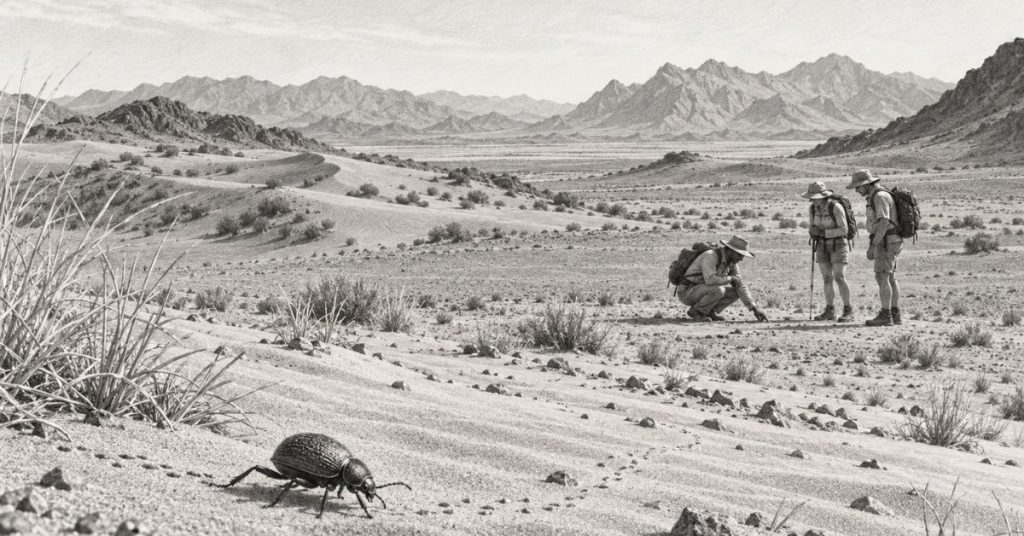
A mark in the sand can interrupt a long view. Near a grass clump, something moves; farther along, a bare circle seems too orderly to have happened by accident.
There is plenty to investigate before lunch.
A desert made of details
NamibRand lies in southern Namibia, beside the Namib-Naukluft National Park. Its ground changes between dunes, gravel plains and mountain country, with habitats meeting along their edges. The walking here is through a varied desert, rather than an uninterrupted expanse of bare sand.
Even the dunes require a little adjustment of expectations. The operator distinguishes the smaller, vegetated dunes on this route from the huge formations at Sossusvlei. This is a walk among the details of the desert, with enough room around them to make bending down seem faintly ridiculous.
Bend down anyway.
There is good published testimony for doing so. In a first-person account for travel company Archipelago Choice, a writer identified as Emma describes walking with a guide named Sebastian. His explanations drew her attention to the desert’s animals and to the evidence they left behind. Her account includes tracks associated with small mammals, as well as the large communal nests of sociable weavers.
It is a commercial travel account, written by a company selling Namibian holidays, and its enthusiasm deserves to be read with that in mind. Still, its useful observation is specific: a guide made the ground interesting. The scenery had already taken care of itself.
For a visitor, tracks offer an encounter with an animal that may never appear. They put an event into the landscape. Something crossed here while the people were elsewhere, or asleep. Knowing the name of the creature adds another layer, but even an unidentified trail changes how closely you look at the next patch of sand.
The difficulty is knowing which marks deserve confidence. A good guide supplies knowledge that a visitor cannot acquire simply by being keen. Guessing at every depression would soon turn a walk into a collection of confident mistakes.
Walking at desert pace
Tok Tokkie’s current itinerary begins with a short afternoon walk, usually one to two hours. The second day is the long one: roughly four to four-and-a-half hours in the morning, then another two to two-and-a-half later, with a shaded lunch break between. It takes walkers over a mountain saddle and down towards a dry riverbed. The final morning returns through dune country. The route can also be walked in reverse.
Those hours deserve more attention than the word ‘leisurely’ in a brochure. Soft sand makes you work for your progress. A short rise can absorb more effort than its height suggests, and your interest in a distant ridge may temporarily give way to an interest in the contents of your water bottle.
A first-person review published by i-escape describes precisely that reduction of pace as its group settled into walking through sand. The reviewer also notes the frequent stops for explanations from the guides. Walking and looking kept interrupting each other.
That seems a sensible arrangement. A desert walk measured only by distance would leave much of the desert unexamined.
How the trail began
The trail’s human history begins with a question from visitors. According to the company’s own account, French guests asked Marc and Elinor Duerr in 1995 why Namibia did not have walking trails. The pair developed the idea in NamibRand, and the first Tok Tokkie departure followed on 25 February 1997. Their base was the former Die Duine farmhouse.
It is a modest origin story for an adventure: someone wanted to get out and walk. The resulting trip has endured by organising the awkward parts around that desire.
Guests carry daypacks. A support team transports the main luggage and provides meals, with bucket showers and outdoor toilet facilities at camp. The advertised group size is normally two to eight.
The comfort makes the effort easier to contemplate. It also makes the staff’s work worth noticing. A bed and a cooked dinner in the dunes are the outcome of transport and preparation. Someone has done a working day so that the walkers can finish theirs with a drink.
Emma’s published account names Lulu and Willy as members of the camp team and credits their practical care, including moving luggage and heating shower water. Their presence gives the familiar expression ‘sleeping in the wilderness’ some necessary company. This version of it depends on people who know how to run a camp.
Conversation on the ground
Beyond the camp, the reserve has its own history of work and repair. NamibRand’s founding idea dates to 1981, and it was registered as a non-profit private nature reserve in 1992. Former livestock farms were brought together for conservation. The reserve describes restoring continuous habitat and enabling wildlife movement as central aims.
That background matters when looking across open country. A visitor might see an ancient landscape and assume that its present condition required nothing from anyone. Here, the conservation project involves decisions about land use, followed by the less photogenic business of maintaining it.
The reserve says fees paid through its tourism concessions support its running costs. For a walker, that provides a concrete connection between the holiday and the place being visited, though it does not make every aspect of travel impact-free. Beds, supplies and vehicles still have to arrive.
Oryx and springbok are prominent large mammals in NamibRand. The reserve also records animals including bat-eared foxes, brown hyenas and African wildcats. Its list of more than 150 recorded bird species offers another reason to bring binoculars. A species list describes possibilities across a reserve, of course; it cannot promise what will appear during one walk.
There is no need to make the smaller encounters compete with a safari checklist. Spending ten minutes examining a beetle is an entirely reasonable use of time on a trail named after beetles. The change in scale is part of the pleasure. Your attention can travel from a mountain to something almost beneath your boot without either being a disappointment.
The puzzle in the sand
Then there are the fairy circles, those bare, roughly circular patches within the grasslands. They bring a scientific argument within walking distance.
Researchers Stephan Getzin and Hezi Yizhaq have studied how water stress affects new grass inside these circles. In research publicised by the University of Göttingen in 2024, they examined 500 individual grass plants across four Namib regions, alongside soil-moisture measurements. Their explanation centres on young grasses drying out in shallow soil while established grasses around the edges have access to deeper moisture. They dispute an explanation involving termites damaging the young roots.
For the traveller, the sensible response is to hear the explanation and keep its attribution attached. The debate has a research history; a roadside conversation need not pretend to settle it. What makes the circles worth stopping for is that an apparently simple patch of bare ground has prompted people to measure what happens beneath it.
A wider Namib
The Namib also needs to be understood as more than one set of conditions. In the neighbouring Namib Sand Sea World Heritage property, UNESCO identifies fog as a major source of water and describes specialist life adapted to the coastal dune environment. That property lies within Namib-Naukluft Park. NamibRand is a separate reserve along the desert’s eastern margin.
The distinction prevents an attractive mistake. A story about a fog-harvesting creature on the coast cannot automatically explain what every animal is doing beside an inland walking trail. Ask where an observation was made. Desert ecology becomes more interesting when the geography stays attached.
Learning desert life
Water also gives the journey a connection to life beyond tourism. The published trail programme includes a visit to the Namib Desert Environmental Education Trust, usually known as NaDEET.
At its NamibRand centre, participants put resource conservation into practice. Solar power supplies electricity, and solar cookers are used to prepare food. Water use is measured, with bucket showers and washing arrangements designed to make consumption visible. The centre hosts programmes for schoolchildren, educators and community groups.
For a visitor passing through, there is something bracing about that purpose. The desert is a place where Namibians come to learn skills they can take home. The holiday occupies a few days of a much longer local undertaking.
Night under a dark sky
Night adds another reason to stay.
NamibRand was designated an International Dark Sky Reserve in 2012. DarkSky International describes it as an unusually dark, accessible place, with night-sky protection now part of its conservation mission.
The reserve’s own account makes clear that this involves management. It has lighting guidelines and has adapted fittings to reduce artificial light, with limits on outdoor brightness included in its planning. A dark sky can look like the absence of effort. Maintaining one around tourist accommodation requires effort of its own.
Sleeping outdoors makes that protection personal. From a stretcher bed, there is no doorway framing the sky and no need to decide whether to step outside for another look. The duvet offers a useful compromise between exposure and comfort. Clouds and moonlight will shape the view; a spectacular sky cannot be ordered with dinner.
Walking on, looking closer
On a return walk, familiarity can make room for a closer look. There has been time to hear explanations, then test how much you can recognise for yourself.
Leave a little room between watching your footing and watching the horizon. Something much smaller may be crossing the sand.